
Industry News
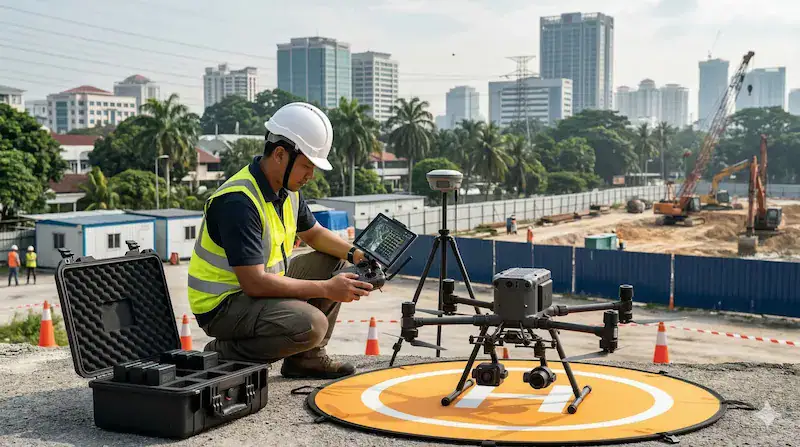
Malaysia’s commercial drone sector has exploded over the last few years. At the enterprise end, you have massive established players like Aerodyne, Aonic, and Meraque running cross-border operations. Down at the other end, there are individual guys with a consumer drone and a YouTube channel who suddenly decided to call themselves a drone services company Malaysia.
For most clients—whether you are a developer needing a site survey, an estate manager looking into agriculture spraying, or a JMB getting quotes for high-rise facade cleaning—the problem isn’t finding an operator. The real headache is figuring out which ones are actually legally compliant, insured, and capable of doing the job right.
Before you sign a contract or pay a deposit, here are the five things that actually matter when evaluating commercial drone operators.
1. CAAM Certification (The Non-Negotiable Baseline)
Every commercial drone pilot operating in Malaysia must hold a Remote Pilot Certificate of Competency – Basic (RCoC-B). This is issued by the Civil Aviation Authority of Malaysia (CAAM). The full compliance requirements are clearly listed on CAAM’s official UAS page.
This is not a polite suggestion. CAAM is actively enforcing these rules, and if you knowingly hire an uncertified operator who crashes on your site, the liability falls on you too.
Asking to see their RCoC-B documentation is the easiest filter you can apply. A real professional will have it attached to their quote immediately. If they hesitate, give you vague answers about “processing,” or try to change the subject, walk away.
(Note for agriculture clients: Agri-drone compliance is currently governed by CAD 6011 Part (II) for Agricultural UAS Operations, and a specific RCoC-AL certification track is incoming soon).
2. ATF Permits: They Should Handle This, Not You
Every commercial flight in Malaysia requires an Authorisation to Fly (ATF) permit. This must be submitted to CAAM a minimum of 14 working days before the job starts. This permit is for your specific site, not a blanket approval for the operator’s general business.
Some “fly-by-night” operators skip this for quick jobs, or worse, expect the client to figure out the paperwork.
Here is what should actually happen: The operator asks for your site’s GPS coordinates, confirms the date, and handles the entire ATF submission as a standard part of their project setup. If you are near an airport or flying in Sarawak (which requires extra clearance from the Premier’s office), a competent operator will flag this immediately and build the lead time into your schedule.
3. Equipment That Actually Matches the Job
Not all drones do all things. It sounds obvious, but equipment mismatch is the number one reason projects fail.
- 3D Mapping & Surveys: If you need survey-grade accuracy for a construction site, the drone must support RTK (Real-Time Kinematic) positioning. A standard consumer DJI drone won’t give you the millimeter accuracy you need for topographic boundaries, no matter how good the pilot is.
- Agriculture Spraying: Look at their payload. Serious agri-drones run 16 to 30-liter tanks. More importantly, ask about their nozzle types (fan nozzles are best for uniform pesticide coverage) and if the system supports variable-rate application.
- Facade Cleaning: The drone is only half the equation. You need to ask about their specific cleaning head system, their ground-tethered water pump, and what pressure range they use to ensure they don’t damage your building’s cladding.
4. Post-Processing: The Flight Isn’t the Product
For any data-collection work, the actual value isn’t in the flying. It’s in the data processing that happens back at the office.
A drone survey that just dumps raw image files on your desk is useless. Depending on your job, you need an orthomosaic map, a 3D point cloud, volumetric earthwork calculations, or a thermal inspection report. All of this requires heavy-duty software and specialized skills.
Always ask what format the final deliverables will be in. If your engineering team uses Autodesk Civil 3D, the drone operator needs to deliver files compatible with that system. Operators who treat the flight as the final product usually deliver outputs that look pretty in a PDF but are useless for real workflow.
5. References from Comparable Work
Having a slick portfolio of sunset aerial photos proves the guy can fly a drone. It proves absolutely nothing about his project management, safety protocols, or what happens when a permit gets delayed.
Ask for references from projects similar to yours. A guy who has filmed five real estate videos doesn’t automatically know how to execute a 300-acre oil palm spraying program or clean a 40-storey glass tower safely.
When you call their references, ask the one question that matters: “When things went wrong—weather delays, site access issues, equipment hiccups—how did they handle it?” ## Price is Not the Primary Signal The pricing for a drone services company Malaysia varies wildly. At the bottom end, cheap operators usually run consumer equipment, lack proper insurance, and skimp on post-processing. But the highest price doesn’t automatically guarantee the best work, either.
Figure out exactly what your project needs, confirm the operator is legally certified to do it, and make sure their equipment matches the scope.
If you are currently evaluating operators for an upcoming project, we are happy to give you a straight, no-nonsense assessment. Reach out to our team at LangiTech Aerial. We will walk you through exactly what we can deliver, how we handle the CAAM compliance, and whether we are the right fit for your site.
Need Help Planning a Compliant Drone Project in Malaysia?
Speak with our team about commercial drone operations, compliance requirements, and the right aerial solution for your project.