
Agriculture Spraying
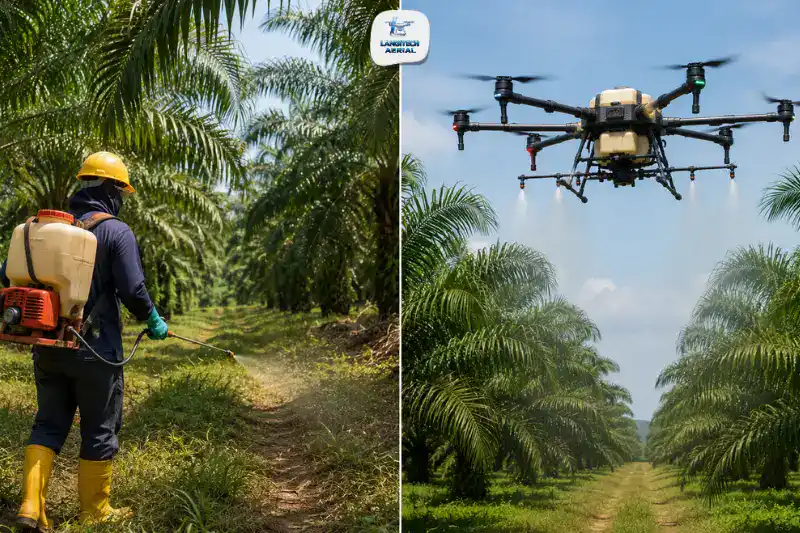
The drone vs manual spraying question is one that every Malaysian plantation manager, estate operator, and farm owner faces eventually. Manual spraying has been the default for decades. However, rising labour costs, worker shortages, and increasing sustainability audit requirements are shifting the economics decisively. This guide compares both approaches across every factor that matters — speed, cost, chemical usage, worker safety, documentation, and the situations where manual still makes sense.
Key Takeaways
- Drone vs manual spraying: a drone covers 15 to 40 hectares per day versus 1 to 3 hectares per worker — a 10 to 40-fold productivity difference
- Drone spraying reduces chemical usage by 25% to 40% and water consumption by up to 90% compared to manual backpack methods
- Manual spraying workers face direct pesticide exposure — a documented occupational health risk under DOSH Malaysia guidelines
- Drone spraying produces GPS-tagged flight logs that directly support MSPO and RSPO certification audits — manual records cannot match this standard
Why the Drone vs Manual Spraying Debate Matters in Malaysia
The Labour Shortage Driving Drone vs Manual Spraying Adoption
The drone vs manual spraying debate in Malaysia is not primarily about technology preference. It is, instead, about a structural workforce problem that has been building for years.
Malaysian plantations — particularly oil palm, rubber, and paddy operations — have historically depended on manual spraying teams. Many of these workers are foreign labour. Consequently, tightening foreign worker policies, rising minimum wage requirements, and post-pandemic supply disruptions have made reliable manual spraying teams increasingly difficult and expensive to maintain.
A single DJI Agras T50 drone, operated by one certified pilot, covers the daily output of 40 manual workers. Furthermore, that drone operates consistently regardless of weather windows, labour availability, or worker fatigue. This is the fundamental economic case for switching — and it applies to estates of all sizes above approximately 20 hectares.
How Drone vs Manual Spraying Differs on Coverage Consistency
Beyond labour availability, manual spraying introduces operational inconsistency. Application rates vary between workers and between sessions. Moreover, steep slopes, waterlogged terrain, and densely planted blocks often receive uneven coverage or are skipped entirely.
Drone spraying, by contrast, follows a pre-programmed path with fixed spray parameters. As a result, every plant in the treated area receives the same dosage — regardless of terrain, crop density, or time of day. This consistency is what drives the yield improvement data that Malaysian estate operators have observed since adopting aerial application.
Drone vs Manual Spraying: Head-to-Head Comparison
Speed and Coverage in Drone vs Manual Spraying
This is the most decisive factor in the drone vs manual spraying comparison for any estate above 20 hectares.
| Coverage Factor | Manual Sprayer | Drone Spraying |
|---|---|---|
| Hectares per worker/drone per day | 1–3 ha | 15–40 ha |
| Team size required | 4–8 workers | 1–2 operators |
| Total coverage for 100 ha estate | 3–5 days | 3–7 hours |
| Terrain sensitivity | High — access issues on slopes | Low — flies above terrain |
For outbreak response — where timing determines yield outcome — the drone vs manual spraying speed gap is critical. A bagworm outbreak spreading across 200 hectares can be treated in one to two days with drone deployment. The same operation with manual teams, however, takes two to three weeks. In that window, uncontrolled bagworm feeding can reduce yields by up to 43% over the following two seasons.
Chemical and Water Usage: Drone vs Manual Spraying
Drone spraying uses ultra-fine atomised droplets at a precisely controlled flow rate. Rotor downwash pushes these droplets deep into the crop canopy. As a result, effective coverage is achieved with significantly less chemical volume than manual methods require.
Compared to conventional manual backpack spraying:
- Chemical reduction: 25% to 40% less pesticide or herbicide per hectare
- Water reduction: Up to 90% less water per hectare through ultra-low volume application
- Drift reduction: Lower drift potential due to controlled spray height and droplet size
For a 500-hectare oil palm estate spraying four times per year, a 30% chemical reduction translates to significant agrochemical procurement savings — often RM 30,000 to RM 80,000 annually, depending on the treatment type.
Worker Safety in Drone vs Manual Spraying
Manual spraying workers carry backpack sprayers filled with pesticides, herbicides, or fungicides. They walk through treated areas and sustain direct skin and respiratory exposure throughout the working day.
According to DOSH Malaysia, prolonged occupational exposure to agricultural pesticides is a documented health risk in Malaysian plantation workers. It is linked to respiratory illness, skin conditions, and longer-term systemic effects. Furthermore, workers in Malaysian estates often operate without consistent protective equipment compliance — increasing their actual exposure beyond what safety guidelines assume.
The drone vs manual spraying safety outcome is clear. The drone operator stands at a safe distance throughout the entire operation. Their only chemical contact occurs during tank filling — a brief, controlled exposure far below the sustained field exposure of manual spraying teams.
Documentation and Traceability
This is the factor most plantation managers overlook. Increasingly, however, it is becoming a compliance requirement rather than a nice-to-have.
Manual spraying documentation typically consists of paper spray records completed after the fact by a supervisor. These records are frequently inconsistent, incomplete, and impossible to verify spatially. Auditors reviewing MSPO or RSPO agrochemical management compliance consistently identify manual spray records as a weak point in estates they audit.
Drone spraying documentation is generated automatically by the flight management system. Every operation produces GPS-tagged flight logs, timestamped coverage maps, chemical volume data per hectare, and operator certification records. As a result, this digital audit trail directly supports the agrochemical management requirements of both MSPO and RSPO certification frameworks.
For estates undergoing sustainability certification — or maintaining existing MSPO or RSPO status — switching to drone spraying provides a documentation upgrade that manual records simply cannot replicate.
Cost Comparison
The drone vs manual spraying cost comparison in Malaysia depends significantly on estate size and treatment frequency. Here are realistic 2026 estimates for oil palm operations:
| Cost Factor | Manual Spraying (est.) | Drone Spraying (est.) |
|---|---|---|
| Labour cost per ha | RM 60–120 | RM 0–20 (operator only) |
| Chemical cost per ha | RM 80–200 | RM 55–150 (30% savings) |
| Total treatment cost per ha | RM 140–320 | RM 80–170 |
| Documentation for MSPO/RSPO | Manual records (weak) | Digital (audit-ready) |
These figures exclude chemical purchase costs where applicable. On estates above 50 hectares, drone spraying consistently delivers a lower total treatment cost per hectare — even after including the provider’s service fee. Moreover, the chemical savings compound over multiple treatment cycles per season.
For a detailed breakdown of drone spraying pricing, read our drone spraying Malaysia cost and ROI guide.
When Manual Spraying Still Makes Sense in Malaysia
The drone vs manual spraying comparison is not winner-takes-all. Manual spraying retains clear advantages in specific situations — and being honest about this helps you make the right decision for your operation.
Small plots under 5 hectares: On very small farms, the minimum service charge for drone operations makes the per-hectare economics unfavourable. Therefore, manual backpack spraying remains cost-effective for smallholders managing plots below 5 hectares.
Spot treatments and individual tree applications: Some treatments — trunk injection for Ganoderma, individual tree pesticide application, or highly localised spot treatment — require physical access to a specific point. Drone spraying covers areas uniformly. It is consequently not designed for single-tree precision on random individuals within a block.
Pre-emergence herbicide on flat open terrain: For flat paddy fields or open vegetable farms, tractor-mounted ground sprayers can match drone coverage rates at lower operating cost per hectare. In this specific context, therefore, drone spraying’s terrain-access advantage largely disappears.
In other words, the most operationally sophisticated Malaysian estates use both methods — drone aerial application for large-area treatments and outbreak response, manual or tractor methods for specific localised tasks. They are complementary tools, not mutually exclusive alternatives.
CAAM Compliance: The Quality Signal in the Drone vs Manual Spraying Market
Manual spraying has no regulatory licensing requirement — anyone can carry a backpack sprayer. By contrast, professional drone spraying providers must meet specific CAAM requirements before deploying commercially. This regulatory distinction is therefore a useful quality signal when evaluating providers.
A legitimate drone spraying provider in Malaysia holds:
- RCoC-B — Remote Pilot Certificate of Competency from CAAM
- UAWC — Unmanned Aerial Work Certificate for aerial application operations
- ATF — Authorisation to Fly for each specific deployment
These credentials do not guarantee quality — but their absence is a clear disqualifier. If a provider cannot confirm all three, they are not operating within Malaysia’s regulatory framework. Furthermore, any incident on your estate involving an uncertified operator creates a liability exposure that falls partly on you for engaging them.
Always request certification documentation before any drone spraying operation begins on your land. For a full guide to drone regulations, read our CAAM drone regulations Malaysia guide.
Frequently Asked Questions
Is drone vs manual spraying worth it for a small oil palm estate in Malaysia?
For estates above 20 to 30 hectares, yes — the economics typically favour drone spraying on treatment cost per hectare, chemical savings, and documentation quality. Below 10 to 15 hectares, however, manual spraying may remain more cost-effective due to drone operation minimum charges. The precise breakeven point therefore depends on your treatment frequency and current manual labour costs.
How much can drone spraying reduce my chemical costs?
Research consistently shows 25% to 40% chemical reduction compared to conventional manual backpack spraying. For example, a 200-hectare estate spraying four times per year at an average chemical cost of RM 120 per hectare achieves approximately RM 28,800 per year in agrochemical savings at a 30% reduction rate — before accounting for labour savings.
Does drone spraying data count towards MSPO certification?
Yes — and this is one of the most underappreciated benefits of switching from manual to drone spraying. Every professional drone operation produces GPS-tagged flight logs, coverage maps, chemical application data, and operator certification records. Consequently, this digital audit trail directly supports agrochemical management requirements in both MSPO and RSPO certification frameworks.
Can I use drone spraying for herbicide application on paddy in Malaysia?
Yes. Drone spraying is widely used for herbicide application across Malaysia’s paddy growing regions — Kedah, Perlis, Sekinchan, and MUDA scheme areas. Flat paddy terrain is operationally straightforward for drones. Furthermore, drone application reduces chemical drift into drainage channels compared to manual methods — a relevant compliance point in MADA and KADA scheme areas where environmental standards are actively monitored.
How do I choose between drone and manual spraying for my operation?
Start with three questions: What is your treated area per cycle? What are your current manual labour costs per hectare? Do you require MSPO or RSPO documentation? If your area exceeds 20 hectares per treatment, your manual costs exceed RM 80 per hectare, or you need auditable agrochemical records — drone spraying is the operationally and economically superior choice. For areas under 10 hectares or for highly localised treatments, manual methods remain practical.
Conclusion
The drone vs manual spraying debate in Malaysia has largely been settled by operational experience. For any estate managing more than 20 hectares per treatment cycle, drone spraying delivers lower total treatment cost, better coverage consistency, significantly reduced worker chemical exposure, and a digital documentation trail that manual records cannot match.
Manual spraying, however, retains a role for small plots, spot treatments, and individual-tree applications. For large-area plantation management across oil palm, paddy, rubber, and durian operations, the case for drone spraying is clear.
The key is therefore engaging a CAAM-compliant provider — one who holds RCoC-B and UAWC certifications, applies for site-specific ATF permits, and delivers complete post-spray documentation with every operation.
LangiTech Aerial provides CAAM-compliant drone spraying services across Peninsula Malaysia for oil palm, paddy, rubber, durian, and other commercial crops.
Contact LangiTech Aerial to discuss your estate’s requirements and get a quote.
For a full guide to our agricultural drone spraying services, visit our drone crop spraying Malaysia guide.
Need Help Planning a Compliant Drone Project in Malaysia?
Speak with our team about commercial drone operations, compliance requirements, and the right aerial solution for your project.