
Agriculture Spraying
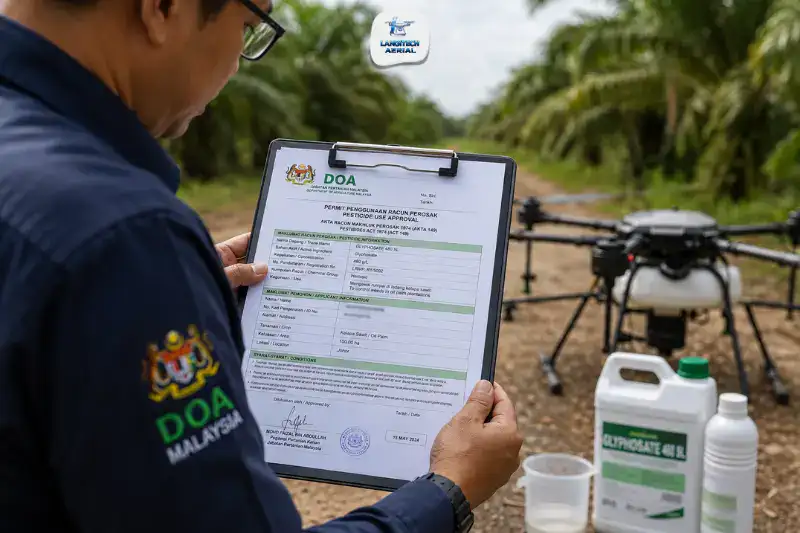
The drone pesticide Malaysia DOA requirement is one of the most misunderstood compliance obligations in the agricultural drone sector. Many operators know about the CAAM UAWC and ATF permit requirements. However, far fewer know about the DOA Agricultural Payload list. The pesticide you apply by drone must appear on this list — a separate approval layer entirely. This guide explains what the list is, why it exists, how to verify your products, and what happens if you operate outside it.
Key Takeaways
- The Department of Agriculture Malaysia maintains the drone pesticide Malaysia DOA Agricultural Payload list. It specifies which products operators can legally apply by drone
- Not all ground-registered pesticides qualify for aerial drone application. Formulation type, droplet behaviour, and drift risk all determine eligibility
- Using a non-listed product exposes the operator and landowner to regulatory penalties and invalid insurance. Potential crop liability also applies
- Always verify with your provider that the specific product they plan to apply appears on the current DOA Agricultural Payload list before any deployment
What Is the DOA Agricultural Payload List?
The DOA Agricultural Payload list is Malaysia’s official register of pesticides, herbicides, fungicides, and fertilisers for UAV spraying operations. The Department of Agriculture Malaysia approves every product on this list specifically for aerial drone delivery. Only listed products qualify for legal drone application in Malaysia.
The list exists because aerial application differs fundamentally from ground-based spraying. A drone’s atomiser nozzles apply chemicals at a different droplet size and height than a backpack sprayer or tractor boom. They also apply at a different concentration. Consequently, a product that safety tests clear for ground use may behave very differently when a drone applies it aerially. It may drift further, evaporate too fast, or deposit at unintended concentrations.
The Agricultural Payload list therefore reflects DOA’s own assessment of which products work safely and effectively in aerial drone delivery under Malaysian conditions. To add a product to the list, the manufacturer must submit data supporting its suitability for aerial application — not just its ground-registered safety profile.
Why Not All Registered Pesticides Qualify for Drone Pesticide Malaysia DOA Applications
Formulation Type Matters
The most important technical factor is the pesticide formulation type. Not all formulation types work reliably in drone spray systems, and some present unacceptable drift or efficacy risks when applied aerially.
EC (Emulsifiable Concentrate): EC formulations work well in drone spraying programmes. They dissolve in water, produce stable spray solutions, and pass through fine atomising nozzles effectively. However, some EC products contain solvents that raise evaporation risk at drone operating heights. Consequently, only DOA-evaluated EC formulations appear on the Agricultural Payload list.
WP (Wettable Powder) and WG (Water-Dispersible Granule): These dry formulations need careful dilution to prevent nozzle blockages in drone spray systems. DOA approves some WP/WG products for aerial application — but not all. Your drone provider must confirm compatibility before deployment.
SC (Suspension Concentrate) and SL (Soluble Liquid): SC and SL formulations suit drone delivery well. They mix easily, produce consistent droplet sizes, and carry lower drift risk at standard drone altitudes. Many SC and SL products appear on the DOA Agricultural Payload list for this reason.
GR (Granular) and DS (Dust): These dry formulations do not work in standard liquid drone spray systems. Granular materials require a dedicated spreading disc attachment. This is a different configuration from the liquid spray payload. Confirm with your provider before assuming a granular product qualifies for drone application.
Droplet Size and Drift Risk
Drone spraying nozzles atomise the spray solution into very fine droplets — typically 100 to 250 microns in Volume Median Diameter (VMD). Fine droplets improve canopy penetration. However, they also increase drift susceptibility in wind conditions.
DOA’s Agricultural Payload evaluation examines whether the active ingredient’s toxicology profile holds up at the drift exposure levels that aerial application generates. Products with high mammalian toxicity may not qualify for aerial application. Those requiring strict buffer zones also face restrictions — regardless of their ground registration status. As a result, the drone pesticide Malaysia DOA list takes a more conservative position than the general pesticide registration register.
Commonly Applied Products in Malaysian Drone Spraying Programmes
While you can access the full DOA Agricultural Payload list directly through the Department of Agriculture, the following active ingredients feature in CAAM-compliant drone spraying programmes across Malaysian plantation crops:
Insecticides
Bacillus thuringiensis (Bt) — Biological Insecticide Bt-based bioinsecticides lead bagworm control programmes on oil palm drone operations. Bt is a naturally occurring bacterium with a narrow pest spectrum. It targets Lepidoptera larvae — bagworms and caterpillars — while posing minimal risk to non-target organisms. Furthermore, MPOB research confirms up to 96% bagworm larval reduction when operators apply Bt by drone. Its safety profile makes it a strong candidate for aerial delivery.
Flubendiamide, Chlorantraniliprole (Diamides) Operators use diamide insecticides in drone programmes for bagworm and leaf-eating caterpillar control. These products carry low mammalian toxicity and favourable environmental profiles. Consequently, they make suitable candidates for aerial application.
Cypermethrin, Deltamethrin (Pyrethroids) Operators apply pyrethroid insecticides across a range of oil palm, paddy, and plantation pest targets. Aerial application status varies by specific formulation — always verify the product name and formulation code against the current DOA list, not just the active ingredient name.
Herbicides
Glyphosate (Systemic) Glyphosate-based herbicides feature widely in Malaysian oil palm and rubber plantation drone herbicide programmes. However, DOA requirements govern specific formulation registrations and application rates for aerial delivery. Not all glyphosate products qualify for aerial application.
Metsulfuron-methyl (Selective Systemic) Operators use metsulfuron-methyl for broadleaf weed control in oil palm. Its low application rate and systemic activity make it suitable for drone delivery in drone pesticide Malaysia DOA programmes.
Paraquat — Status Note Paraquat features widely in Malaysian plantation ground-based programmes. However, MSPO and RSPO sustainability frameworks increasingly restrict its use. Verify its current status on the Agricultural Payload list and your sustainability certification requirements before including it in drone programmes.
Fungicides
Mancozeb, Azoxystrobin Operators apply these contact and systemic fungicides for disease management in oil palm, paddy, and rubber. Aerial application status depends on the specific formulation — verify against the current DOA list before deployment.
How to Verify the DOA Agricultural Payload List
The Department of Agriculture Malaysia maintains and updates the current Agricultural Payload list. To confirm whether a specific product is approved for drone pesticide Malaysia DOA applications:
Step 1 — Contact DOA Malaysia directly. The Pesticide Control Division within DOA manages the Agricultural Payload list. Contact them at www.doa.gov.my or visit a regional DOA office. Provide the specific product name, formulation code, and registration number.
Step 2 — Ask your drone provider. A professional, CAAM-compliant drone spraying provider confirms the products they plan to use against the current DOA Agricultural Payload list before any deployment begins. If they cannot do this, treat it as a red flag.
Step 3 — Check the CAAM CAD 6011 Part II documentation. CAAM’s Civil Aviation Directive Part 6011 Part II for Agricultural UAS Operations cites the DOA Agricultural Payload list as the authoritative reference for approved aerial products. Reading this directive also clarifies the operational requirements surrounding product application.
Consequences of Using Non-Listed Products
Operating a drone pesticide Malaysia DOA programme with a product that is not on the Agricultural Payload list carries serious consequences.
Regulatory violation: Using a non-listed product violates the Pesticides Act 1974 and CAAM’s CAD 6011 Part II requirements. Both the drone operator and the contracting landowner may face regulatory action from multiple agencies.
Insurance invalidation: Commercial drone insurance policies require operations to fall within all relevant regulatory approvals. A non-listed product deployment voids coverage for crop damage and third-party harm. Environmental incident claims also lose coverage.
Crop liability: If a non-listed product causes phytotoxicity to the treated crop, the operator loses any regulatory defence. Drift damage to neighbouring crops carries the same outcome. Liability falls directly on the operator and potentially the contracting estate.
MSPO/RSPO audit failure: Sustainability certification auditors scrutinise agrochemical management records closely. An audit trail showing drone application of non-DOA-approved products results in a direct certification compliance failure.
What to Ask Your Provider Before Deployment
Before committing to any drone pesticide Malaysia DOA spraying programme, ask your provider these four questions:
- Is the specific product you plan to use on the current DOA Agricultural Payload list? Ask for the product name, formulation code, and registration number — not just the active ingredient name.
- Do you hold a current UAWC from CAAM? The Unmanned Aerial Work Certificate is mandatory for all commercial drone spraying operations.
- Have you applied for the ATF (Agricultural) permit at drone.agr@caam.gov.my for this specific deployment?
- Can you provide the post-spray report showing the specific product applied, rate, and coverage area?
A compliant, professional provider answers all four clearly and in advance.
For a full guide to CAAM compliance requirements for drone spraying, read our CAAM drone regulations Malaysia guide.
Frequently Asked Questions
What is the DOA Agricultural Payload list in Malaysia?
The DOA Agricultural Payload list is the Department of Agriculture Malaysia’s register of pesticides, herbicides, fungicides, and other agricultural substances for UAV spraying. DOA maintains it separately from the standard Pesticides Act registration. A product must appear on both the general register and the Agricultural Payload list to qualify for legal drone application.
Can I use any DOA-registered pesticide in my drone spraying programme?
No. Standard DOA pesticide registration covers ground-based application methods only. For a product to qualify for drone spraying, it must specifically appear on the Agricultural Payload list for aerial UAV application. Using a ground-only registered product aerially is a regulatory violation. This applies regardless of how widely operators apply it on the ground.
How do I check if a specific product is on the DOA Agricultural Payload list?
Contact the Pesticide Control Division at the Department of Agriculture Malaysia through their website at www.doa.gov.my. Provide the specific product name, formulation code, and DOA registration number. Alternatively, ask your drone spraying provider to confirm the aerial list status of any product they intend to use before deployment.
What happens if my drone spraying provider uses a non-listed product?
Both the provider and the contracting landowner may face regulatory action under the Pesticides Act 1974 and CAAM’s CAD 6011 Part II. Insurance coverage voids immediately. Crop damage liability falls directly on the parties involved. Furthermore, any MSPO or RSPO sustainability audit that finds evidence of non-approved aerial product use results in a direct compliance failure.
Conclusion
The drone pesticide Malaysia DOA Agricultural Payload list is a critical compliance requirement that estate managers and farm operators need to understand — not just drone operators. Knowing which products DOA approves for aerial application protects you from regulatory exposure, insurance gaps, and sustainability audit failures.
Always verify the specific product — not just the active ingredient — before any drone spraying deployment begins. A professional provider manages this verification as part of their standard service.
LangiTech Aerial uses only DOA Agricultural Payload-listed products in all our drone spraying operations across Peninsula Malaysia. We confirm product compliance before every deployment and document it in our post-spray reports.
Contact LangiTech Aerial to discuss your crop protection programme and get a compliant drone spraying quote.
For a broader guide to our agriculture drone services, read our drone crop spraying Malaysia guide.
Need Help Planning a Compliant Drone Project in Malaysia?
Speak with our team about commercial drone operations, compliance requirements, and the right aerial solution for your project.