
Agriculture Spraying
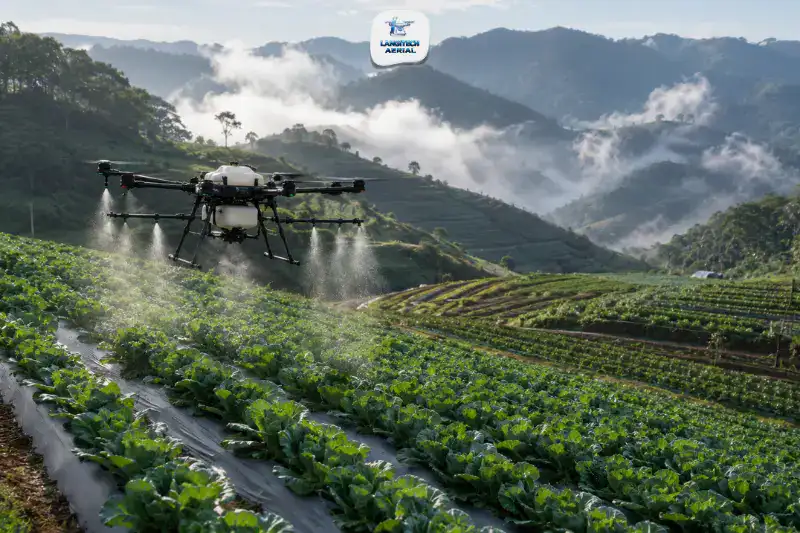
Vegetable drone spraying Malaysia gives commercial vegetable farmers and mixed crop operators a practical way to manage pests, diseases, and weeds across their plots — faster, more uniformly, and with far less labour than manual methods allow. From the cool highland farms of Cameron Highlands and Fraser’s Hill to the lowland leafy vegetable operations of Selangor and the large commercial farms of Johor, drone spraying is increasingly part of professional vegetable farm management. This guide covers how it works for vegetable crops specifically, the critical food safety considerations, and how to work with a CAAM-compliant provider.
Key Takeaways
- Vegetable drone spraying Malaysia covers leafy vegetables, brassicas, fruiting vegetables, and mixed crop farms — both highland and lowland operations
- Pre-harvest intervals (PHI) are a critical food safety requirement for vegetable crops — ensure your provider confirms PHI compliance for every product they apply
- Drone spraying settings for fragile vegetable crops differ from plantation spraying — lower pressure, finer droplets, and slower flight speeds protect delicate leaves
- All commercial vegetable drone spraying operations require CAAM RCoC-B + Module 2 (AGR) certification, UAWC, and an ATF from CAAM
Why Vegetable Farmers in Malaysia Are Adopting Drone Spraying
The Labour Challenge on Malaysian Vegetable Farms
Malaysian vegetable farming — whether on the cool highland terraces of Cameron Highlands or the flat lowland farms of Sekinchan and Sabak Bernam — depends heavily on manual labour for pest control and weed management. Spraying teams walk between plant rows with backpack sprayers, applying pesticide and herbicide by hand throughout the growing season.
Labour availability for this work has become increasingly unreliable. Furthermore, direct pesticide exposure during manual application creates occupational health risks that farm operators struggle to manage effectively. Vegetable drone spraying Malaysia addresses both problems — one drone operator covers the work of a manual spraying team, and workers stay out of the treated area entirely.
The Timing Challenge on Short Crop Cycles
Vegetable crops have short growing cycles — typically 3 to 8 weeks from transplanting to harvest for leafy varieties. This compresses the window for effective pest and disease management significantly. A pest outbreak that goes untreated for 3 to 4 days on a leafy vegetable crop can cause damage that is impossible to recover before harvest.
Drone spraying allows farm operators to deploy treatment quickly — often within a day of identifying a pest problem — without waiting for a manual team to mobilise. As a result, critical-window treatment becomes operationally feasible on vegetable farms in a way that scheduled manual spray programmes cannot achieve.
How Vegetable Drone Spraying Malaysia Differs from Plantation Spraying
Vegetable drone spraying Malaysia requires different technical settings from oil palm or paddy drone spraying. Fragile vegetable crops need a gentler approach — and a good provider adjusts accordingly.
Lower Pressure and Finer Droplets
Leafy vegetables — kailan, bayam (spinach), kangkung, lettuce, and cabbage — have delicate leaf surfaces and tender growth points. High-pressure application or large droplets can cause physical damage to leaves, bruising or splitting the tissue in ways that affect market quality.
Professional vegetable drone spraying Malaysia uses fine-droplet atomising nozzles at lower flow rates than plantation spraying configurations. Specifically, droplet sizes in the 50 to 150 micron range provide effective pest coverage while minimising mechanical impact on vegetable leaf surfaces.
Slower Flight Speed
Flight speed directly affects spray droplet density on the target surface. For vegetable crops with dense canopy growth — brassicas, chillies, capsicum — slower drone flight increases the dose per unit area and improves penetration between leaves. A competent provider adjusts flight speed per crop type rather than using a single standard setting for all operations.
Terrain-Following Mode for Cameron Highlands
Highland vegetable farms in Cameron Highlands, Fraser’s Hill, and Bukit Fraser present a unique terrain challenge. Terraced hillside farms on slopes of 15° to 30° or steeper require terrain-following flight mode — where the drone’s altitude adjusts automatically to maintain a consistent height above the crop surface, regardless of the slope angle beneath it.
This is the same principle that makes hilly terrain oil palm spraying more complex than flatland operations. For vegetable drone spraying Malaysia on slope farmland, always confirm your provider uses terrain-following mode — standard flat-terrain flight programming produces inconsistent coverage on sloped vegetable beds.
Vegetable Drone Spraying Malaysia by Crop Type and Region
Cameron Highlands and Pahang Highlands — Cool Climate Vegetables
Cameron Highlands is Malaysia’s most important highland vegetable production area. It supplies a significant portion of the country’s cool-climate vegetables — cabbage, broccoli, cauliflower, tomatoes, capsicum, and leafy greens — to markets across the Peninsula.
Key pest and disease pressures in Cameron Highlands include:
- Diamondback moth (Plutella xylostella) on brassicas — one of the most economically damaging pests in highland vegetable farming
- Thrips and aphids on capsicum and tomatoes
- Downy mildew and grey mould — fungal diseases favoured by Cameron Highlands’ cool, humid conditions
- Weed pressure between terrace rows — herbicide application with narrow-targeted flight paths
Vegetable drone spraying Malaysia on Cameron Highlands terrain requires terrain-following flight mode, fine-droplet nozzles calibrated for brassica leaf surfaces, and fungicide formulations appropriate for highland humidity conditions.
Selangor Lowland — Leafy Vegetables and Chinese Greens
Selangor’s lowland vegetable areas — Sekinchan, Sabak Bernam, Rawang, and Klang Valley peri-urban farms — produce high volumes of short-cycle leafy vegetables including kailan, choy sum, bayam, kangkung, and lettuce.
These operations run intensive planting cycles with multiple harvests per year. Consequently, effective and fast pest management is critical to yield consistency. Drone spraying delivers herbicide and pesticide applications on tight schedules — matching the demanding rotation cycles of commercial lowland vegetable farming.
Research conducted in Sungai Besar, Sabak Bernam, confirmed that applying herbicides via drone in direct-seeded rice and adjacent vegetable plots achieved equivalent or better weed control compared to mist blower application — while reducing labour input and application time significantly.
Johor and Pahang — Large Commercial Vegetable Operations
Johor and Pahang host Malaysia’s largest commercial vegetable farms — including large-scale chilli, cucumber, tomato, and capsicum operations for domestic and export markets. These farms operate at scales where drone spraying economics are clearly favourable. Furthermore, their professional management structure makes CAAM-compliant drone programmes straightforward to integrate into existing farm management systems.
Pre-Harvest Interval (PHI) Compliance — The Critical Food Safety Requirement
This is the most important aspect of vegetable drone spraying Malaysia that no competitor covers — and it directly affects the safety of the food reaching Malaysian consumers and export markets.
What is a Pre-Harvest Interval? A Pre-Harvest Interval (PHI) is the minimum number of days that must pass between the last pesticide or herbicide application and harvesting of the crop for consumption. PHIs exist because pesticide residues degrade over time — the PHI ensures residue levels have fallen below the Maximum Residue Limit (MRL) before the crop reaches the market.
PHIs vary by pesticide product and crop type. For example:
- A fungicide cleared for use on brassicas might carry a PHI of 7 days
- An insecticide for aphid control on leafy vegetables might carry a PHI of 3 to 14 days
- A herbicide applied to vegetable inter-rows carries its own separate PHI
Why PHI Matters on Vegetable Farms Vegetable farms with short crop cycles face a specific risk: applying a pesticide too close to harvest results in residues above MRL in the harvested crop. This creates food safety violations, market rejection, and potential regulatory action under the Food Act 1983 and Pesticides Act 1974.
Drone spraying speeds up application. However, this does not shorten PHI requirements. Therefore, always confirm with your provider that the specific product they plan to apply carries a PHI compatible with your remaining harvest window.
A professional vegetable drone spraying Malaysia provider confirms PHI compatibility as part of their pre-application planning. If a provider cannot cite the specific PHI for each product they plan to apply, do not proceed.
Organic-Compatible Options for Premium Vegetable Drone Spraying Malaysia
Some Malaysian vegetable farmers targeting premium markets — export, supermarket supply chains, or certified organic channels — require spraying solutions compatible with Good Agricultural Practice (GAP) or organic production standards.
Biological pesticide options compatible with drone delivery on vegetable crops include:
- Bacillus thuringiensis (Bt) — for caterpillar and diamondback moth control on brassicas, with minimal environmental impact and short PHI
- Spinosad-based products — for thrips and leafminer control with acceptable residue profiles for premium market supply
- Neem-based formulations — broad-spectrum insect repellent with very short PHI, suitable for near-harvest applications
Confirm with DOA Malaysia that your intended biological product appears on the Agricultural Payload list for aerial drone application before deploying. As with conventional pesticides, only products specifically cleared for aerial drone use qualify for drone application.
CAAM Compliance for Vegetable Drone Spraying Malaysia
The same CAAM compliance requirements that apply to oil palm and paddy drone spraying apply to vegetable farms. Specifically, your provider must hold:
- RCoC-B + Module 2 (AGR) — pilot agricultural operations endorsement
- UAWC — Unmanned Aerial Work Certificate from CAAM for the operating company
- ATF (Agricultural) — submitted to drone.agr@caam.gov.my at least 14 working days before each deployment
For farms in Cameron Highlands, Fraser’s Hill, and other highland areas with complex terrain, the ATF application must also account for elevation and terrain in the operational parameters. LangiTech Aerial manages these specific requirements for highland vegetable drone spraying operations.
Vegetable Drone Spraying Malaysia Cost Guide
Pricing varies by farm size, terrain complexity, crop type, and treatment frequency. As a guide for 2026 Malaysian market conditions:
| Farm Size / Type | Typical Range (RM per ha) |
|---|---|
| Small lowland vegetable farm (< 5 ha) | RM 100 – RM 200 per ha |
| Medium commercial farm (5–20 ha) | RM 80 – RM 150 per ha |
| Highland farm (terrain-following mode) | RM 150 – RM 300 per ha |
| Grouped smallholder programme | Lower rate — see grouped pricing |
Chemical costs are typically excluded from these rates. Confirm whether your provider includes or excludes chemical supply in their quote.
For a broader overview of drone spraying costs across all crops, read our drone vs manual spraying Malaysia guide.
Frequently Asked Questions
Is drone spraying safe for fragile vegetable crops?
Yes — when the provider uses appropriate settings. Vegetable drone spraying Malaysia requires lower pressure, finer droplet sizes, and slower flight speeds than plantation spraying. These settings protect delicate leaves from physical spray damage while delivering effective pest and disease coverage. Always ask your provider to confirm the nozzle configuration and flight parameters they use for your specific crop type.
What is the pre-harvest interval and why does it matter for vegetable drone spraying?
The pre-harvest interval (PHI) is the minimum days required between the last pesticide application and harvest. PHIs ensure residue levels in harvested crops fall below Maximum Residue Limits (MRL) before they reach consumers. On short-cycle vegetable crops, the PHI of each applied product must align with your harvest schedule. Always confirm PHI compatibility with your provider before any vegetable drone spraying deployment.
Can drones spray on the terraced hillside farms in Cameron Highlands?
Yes — using terrain-following flight mode, which automatically adjusts drone altitude to maintain a consistent height above sloped crop surfaces. This ensures uniform spray coverage regardless of the slope angle. Confirm that your provider uses terrain-following mode specifically for highland vegetable operations. Standard flat-terrain flight programming produces inconsistent coverage on Cameron Highlands terraced farms.
How often should vegetable farms schedule drone spraying in Malaysia?
Spray frequency depends on pest and disease pressure, crop growth stage, and PHI requirements. Most commercial vegetable operations schedule treatments every 7 to 14 days during active growing periods. During pest outbreak events, drone spraying allows rapid same-day or next-day deployment — critical for protecting short-cycle crops before harvest. Work with your agronomist to define a spray programme that matches your crop rotation and market requirements.
Conclusion
Vegetable drone spraying Malaysia gives farm operators faster treatment response, more consistent coverage, and lower worker chemical exposure than manual methods — at every scale from small highland terrace plots to large commercial Johor vegetable operations.
The key considerations for vegetable farms are specifically: ensure your provider uses crop-appropriate nozzle settings, confirm PHI compliance for every product applied, and for highland operations, verify terrain-following mode capability.
LangiTech Aerial provides CAAM-compliant vegetable drone spraying Malaysia services across Peninsula Malaysia — covering lowland leafy vegetables, highland cool-climate crops, and large commercial vegetable operations.
Contact LangiTech Aerial to discuss your farm’s requirements and get a spraying quote.
For a broader guide to our agriculture drone services, read our drone crop spraying Malaysia guide.
Need Help Planning a Compliant Drone Project in Malaysia?
Speak with our team about commercial drone operations, compliance requirements, and the right aerial solution for your project.