
Agriculture Spraying
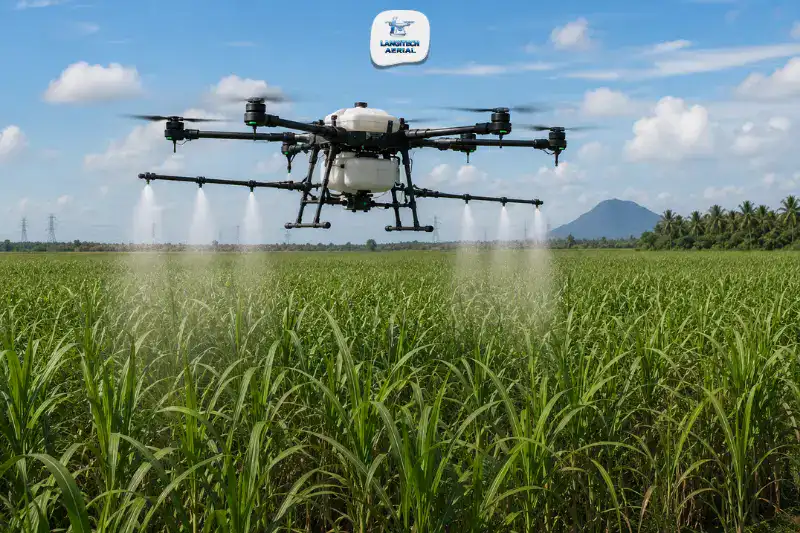
Sugarcane drone spraying solves a problem that manual application cannot: tall crop canopy. Mature sugarcane in Malaysia grows to 3 to 4 metres, a barrier that blocks manual backpack sprayers from reaching the upper canopy where pests concentrate, and that makes ground equipment impractical after the grand growth stage. Drones fly above this canopy at consistent spray height, delivering chemical to the upper stalk and leaf surface regardless of crop height. This guide explains how sugarcane drone spraying works at each growth stage, the unique ripener application that only sugarcane requires, and what Malaysian operators need to know about CAAM compliance.
Key takeaways
- Sugarcane drone spraying Malaysia covers four distinct growth stage applications: establishment herbicide, vegetative pest control, grand growth weed management, and ripener delivery at maturity.
- The tall sugarcane canopy, 3 to 4 metres at maturity, makes manual spraying ineffective after the vegetative stage. Drone delivery overcomes this entirely.
- Ripener chemical application by drone is a sugarcane-specific use case that significantly improves sucrose content and harvest uniformity.
- All commercial sugarcane drone spraying operations in Malaysia require CAAM RCoC-B + Module 2 (AGR), UAWC, and an ATF before deployment.
Why sugarcane needs drone spraying
The tall crop problem
Sugarcane presents a spraying challenge that most other Malaysian crops do not. Oil palm, paddy, and rubber can all be reached by ground-based manual applicators at the critical application points. Sugarcane, though, grows rapidly from ground level to 3 to 4 metres of dense stalk and leaf mass within 4 to 6 months of planting.
Manual backpack sprayers cannot effectively reach the upper canopy of mature sugarcane. Workers spraying from the base push chemical at the lower stalk, largely missing the leaf surface where fungal spores and insect populations concentrate. Entry between dense rows of tall cane at 3 to 4 metres height is also physically demanding and creates direct chemical exposure risk throughout the walking distance.
Sugarcane drone spraying delivers chemical from above the canopy at a programmed height of 1.5 to 3 metres above the top of the cane. The drone’s rotor downwash pushes spray droplets downward through the canopy, so coverage reaches the leaf axils and upper stalk surfaces where pest and disease populations establish. Manual ground application cannot match this coverage after the early growth stage.
The Malaysian sugarcane industry context
Malaysia’s domestic sugarcane industry concentrates primarily in Perlis, Kedah, and northern Johor, with significant growing areas in Chuping (Perlis) and other locations in the northern states. The Malaysian Sugar Board (MPB) oversees sugarcane cultivation and sugar production standards for the domestic industry.
Malaysian sugarcane plantations range from small contract growers supplying sugar mills to larger managed blocks. Labour availability for manual spraying is a persistent challenge, particularly during the peak pest pressure periods that often coincide with the wet season, when worker access between rows is most difficult.
Sugarcane drone spraying at each growth stage
Sugarcane has a growth cycle of 12 to 18 months from planting to harvest. Each growth stage creates specific drone spraying opportunities.
Establishment stage: pre and post-emergence herbicide
In the early weeks after planting, sugarcane seedlings emerge slowly and remain short. Weeds germinate faster and compete aggressively for soil nutrients and moisture. This stage is the most critical window for herbicide intervention.
Sugarcane drone spraying at the establishment stage applies pre-emergence herbicide to the bare soil between rows before weeds break the surface. If early weed emergence occurs despite pre-emergence treatment, post-emergence contact herbicide targets weed seedlings while the sugarcane crop is still short enough for ground equipment to operate.
The advantage of drone application at this stage is speed and coverage uniformity. A single drone covers the entire planting area in hours, ensuring that the pre-emergence chemical barrier applies across all rows within the critical timing window.
Vegetative phase: fungicide and pest management
During the vegetative phase, sugarcane grows rapidly. The canopy closes as stalks reach 1 to 2 metres, making row entry increasingly difficult for manual sprayers.
Key pest and disease pressures at this stage include:
- Stem borers (Chilo sacchariphagus, Sesamia inferens): damage to the growing point and stalk interior
- White grub: root damage from soil-stage larvae
- Smut and red rot fungal diseases: early intervention with fungicide prevents spread across the stand
- Aphid and mealybug infestations: concentrated at leaf axils in the upper canopy
Sugarcane drone spraying at the vegetative phase delivers insecticide and fungicide to the upper canopy precisely where these pests and diseases establish. Treatment reaches the target area that manual sprayers at ground level cannot access effectively.
Grand growth stage: broadleaf weed management
During grand growth, when sugarcane reaches its maximum height of 3 to 4 metres, row entry for manual spraying is no longer practical. Canopy closure between rows creates a dense, confined environment with high chemical exposure risk and extremely limited spray reach.
Sugarcane drone spraying is the only practical option for targeted herbicide delivery at this stage. The drone applies broadleaf herbicide above the canopy, allowing droplets to penetrate the closed stand through the rotor downwash effect.
Treatment accuracy also matters at this stage. Broad-spectrum herbicides that drift beyond the target area can damage neighbouring crops. Drone delivery at controlled droplet size and consistent height minimises this drift risk compared to manual application or fixed-wing aircraft.
Ripening stage: ripener chemical application
The ripener application is the most sugarcane-specific use case, and the one Malaysian operators are least likely to have considered for drone delivery.
Ripener chemicals, such as Ethephon and Glyphosate at low ripening rates, apply in the final weeks before harvest to:
- Accelerate sucrose accumulation in the stalk
- Synchronise maturity across the stand for more uniform harvest quality
- Reduce the moisture content of the stalk for better mill processing efficiency
Traditionally, ripener application in larger sugarcane operations globally uses fixed-wing aircraft or helicopters. Fixed-wing aircraft apply at high speeds, though, creating significant chemical drift that affects neighbouring plots. Sugarcane drone spraying at the ripening stage delivers ripener at precisely controlled rates, at the right canopy height, with minimal drift, protecting adjacent crops and ensuring consistent sucrose enhancement across the stand.
This is a yield management approach that most Malaysian sugarcane operations have not yet adopted via drone. No Malaysian drone service provider currently covers ripener application as a standard offering, which makes it a genuine differentiation opportunity for plantation operators wanting to improve their mill sucrose delivery.
Weed mapping and targeted sugarcane drone spraying
Research on sugarcane drone spraying programmes shows that combining aerial weed pressure mapping with targeted drone application reduces herbicide usage by up to 85% compared to blanket application across the entire plantation.
The workflow follows the same model as precision oil palm herbicide management:
- Pre-spray drone mapping: aerial imagery or multispectral survey identifies weed density zones across the sugarcane stand.
- Zone-based treatment plan: high-density zones receive full-rate herbicide; low-density zones receive reduced rates or targeted spot treatment.
- Targeted drone application: the spraying drone executes treatment at zone-specific rates.
For Malaysian sugarcane operators managing large blocks, this approach significantly reduces total herbicide cost per season. The documented weed management records also support good agricultural practice compliance under DOA Malaysia guidelines.
Malaysian climate considerations for sugarcane drone spraying
Malaysia’s tropical climate introduces specific considerations for sugarcane drone spraying timing.
Morning operations work best. The optimal spraying window is typically 7am to 10am, before ambient temperatures rise above 32°C and wind speeds increase. High temperatures accelerate droplet evaporation before the chemical reaches the target leaf surface.
Rain avoidance matters too. Chemical applications require 2 to 4 hours of dry conditions after spraying for adequate uptake. In Malaysia’s unpredictable rainfall pattern, operators should plan spraying sessions during the drier inter-monsoon windows or early mornings when afternoon convective rainfall is less likely.
Malaysia’s consistently high humidity (70% to 90%) actually benefits sugarcane drone spraying by slowing droplet desiccation, allowing systemic chemicals more time to penetrate leaf surfaces after deposition. This is an advantage over drier climates where droplet desiccation limits uptake.
CAAM compliance for sugarcane drone spraying
The same CAAM compliance requirements apply to sugarcane drone spraying as to all commercial agricultural drone operations in Malaysia:
- RCoC-B + Module 2 (AGR): pilot agricultural operations endorsement from CAAM
- UAWC: Unmanned Aerial Work Certificate from CAAM for the operating company
- ATF (Agricultural): submitted to
drone.agr@caam.gov.myat least 14 working days before each deployment
All products applied must also appear on the DOA Malaysia Agricultural Payload list for aerial drone application. This includes ripener chemicals, so verify specific product approvals before deployment.
For a full compliance guide, read our CAAM drone regulations Malaysia guide.
Sugarcane drone spraying cost guide
Pricing for sugarcane drone spraying in Malaysia varies by treatment type, field size, and crop height:
| Application type | Typical range (RM per ha) |
|---|---|
| Establishment herbicide (short crop) | RM 80 to RM 130 per ha |
| Vegetative/grand growth pest control | RM 100 to RM 160 per ha |
| Ripener application | RM 90 to RM 150 per ha |
| Programme rate (3+ visits per season) | Lower rate: contact for quote |
Chemical costs are excluded from these rates unless the provider includes chemical supply in their quoted package. Always clarify this before comparing quotes.
Frequently asked questions
Why is drone spraying better than manual for mature sugarcane?
At 3 to 4 metres tall, mature sugarcane physically prevents effective manual spraying. Workers at ground level cannot reach the upper canopy and leaf axils where pest populations concentrate. Drone spraying delivers chemical from above the canopy at a consistent height. The drone’s rotor downwash pushes spray droplets downward through the stand, achieving coverage that manual methods cannot replicate at this crop height.
What is ripener application and why does sugarcane need it?
Ripener chemicals encourage sugarcane stalks to accumulate sucrose in the final weeks before harvest, improving the sugar yield per tonne of cane delivered to the mill. Drone application delivers ripener at precise rates across the entire stand, synchronising maturity and improving mill sucrose returns. It is a yield management tool specific to sugarcane that no other Malaysian crop requires.
How many hectares can a drone spray per day on a sugarcane plantation?
At the establishment stage when crops are short, a DJI Agras T50 covers 20 to 40 hectares per day. At the vegetative and grand growth stages when drone spraying height increases above the canopy, coverage rate depends on the application rate and flight altitude, typically 15 to 30 hectares per day for pest management applications.
When is the best time to schedule sugarcane drone spraying in Malaysia?
Plan pre-emergence herbicide within 3 to 5 days of planting. Vegetative pest management runs from the 2 to 6 month stage as the canopy develops. Ripener application targets the 2 to 4 week window before planned harvest. For all applications, morning operations (7am to 10am) avoid peak heat and wind, so confirm timing with your provider before scheduling.
Getting started
Sugarcane drone spraying gives Malaysian plantation operators consistent, full-canopy chemical delivery at every growth stage, from establishment herbicide to ripener application at harvest. The tall crop barrier that defeats manual spraying is simply not a factor when the drone operates above the canopy.
The ripener application is particularly underutilised in Malaysian operations and is a direct yield improvement pathway for operators wanting to improve sucrose delivery to their mill.
LangiTech Aerial provides CAAM-compliant sugarcane drone spraying services across Peninsula Malaysia, covering herbicide, pest control, fungicide, and ripener applications for all plantation scales.
Contact LangiTech Aerial to discuss your sugarcane programme and get a site-specific quote.
For a broader guide to our agriculture drone services, read our drone crop spraying Malaysia guide.
Need Help Planning a Compliant Drone Project in Malaysia?
Speak with our team about commercial drone operations, compliance requirements, and the right aerial solution for your project.