
Industry News
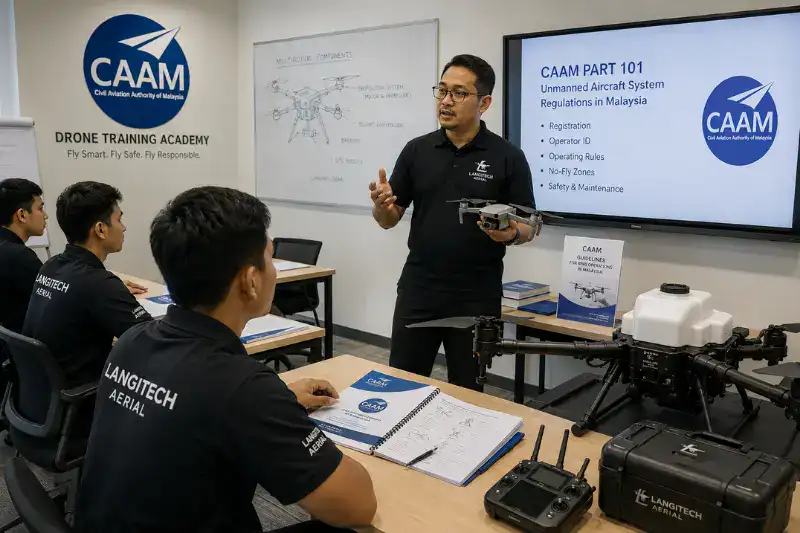
A drone pilot course in Malaysia gives you the certification you need to operate a drone commercially, legally and compliantly under CAAM regulations. The core qualification is the Remote Pilot Certificate of Competency (Basic), or RCoC-B, and CAAM requires every commercial drone operator in Malaysia to hold one. This guide covers which course type you need, how much it costs, which approved providers to consider, and, critically, how to access government-subsidised or free drone training if you qualify.
Key takeaways
- The RCoC-B is Malaysia’s mandatory drone pilot certification for commercial operations. Training takes 5 days at a CAAM-approved RPTO and typically costs RM2,000 to RM3,500.
- Agriculture operators need RCoC-B plus Module 2 (AGR). The 2026 RCoC-AL is a new lighter category for private agricultural use on your own land.
- Government-subsidised drone pilot courses in Malaysia are available through MRANTI, RISDA, MARA, and DOA Malaysia. Eligible individuals may pay reduced fees or nothing at all.
- After certification, commercial drone operators still need a CAAM ATF for each deployment. The RCoC-B alone does not authorise you to fly commercially.
Which drone pilot course do you need?
The right course depends on what you plan to do with your certification.
RCoC-B (Basic): for most commercial operators
The RCoC-B is the foundation certificate for all commercial drone pilots. It covers Visual Line of Sight operations for drones under 20kg. So if you plan to work in aerial photography, drone mapping, building inspection, or drone cleaning, the RCoC-B is where you start.
The standard RCoC-B course runs 5 days and covers air law, drone systems, meteorology, and operational procedures. You also sit a written theory examination (minimum 75% pass mark) and complete a practical flight assessment.
RCoC-B plus Module 1 (EVLOS): for extended range operations
Module 1 enables Extended Visual Line of Sight operations, where visual observers extend your operational range beyond your direct sight line. This module suits long linear corridor surveys, power line inspections, and large area mapping. It’s an add-on to the RCoC-B, not a standalone course.
RCoC-B plus Module 2 (AGR): for commercial agriculture spraying
Module 2 enables commercial agricultural drone operations, including crop spraying, fertiliser application, and any dispensation of agricultural payloads. If you work in commercial drone spraying, you need this combination. In addition, the company that employs or contracts you must hold a UAWC (Unmanned Aerial Work Certificate).
RCoC-AL (Agricultural Light): new 2026 category
CAAM introduced the RCoC-AL in 2026 as a lighter certification pathway for farmers who operate drones on their own land for personal agricultural use. It’s not a commercial certification, so it doesn’t qualify you for commercial drone spraying services. That said, it’s a viable and less costly route for smallholder farmers who want to self-operate drone spraying on their own plots.
For full certification details, read our RCoC drone pilot Malaysia guide.
Fees and what’s included
Standard market rates for drone pilot courses in Malaysia in 2026:
| Course | Duration | Typical fee (RM) |
|---|---|---|
| RCoC-B (Basic) | 5 days | RM2,000–RM3,500 |
| Module 1 (EVLOS) add-on | 2–3 days | RM800–RM1,500 |
| Module 2 (AGR) add-on | 2–3 days | RM1,000–RM2,000 |
| RCoC-B plus Module 2 bundle | 7–8 days | RM2,800–RM4,500 |
| RCoC-AL (Agricultural Light) | 3–4 days | RM1,200–RM2,500 |
These fees typically include training materials, drone use during practical assessments, and examination administration. However, always confirm what the quoted fee covers before enrolling, since some providers charge examination fees or re-sit costs separately.
Government-subsidised and free drone pilot courses
This is the question most people search for but few guides actually answer. Several government programmes offer subsidised or fully funded drone pilot courses in Malaysia, if you meet the eligibility criteria.
MRANTI
MRANTI (under MOSTI) has run drone training and deployment programmes as part of Malaysia’s precision agriculture and technology adoption initiatives. The PTK2Dron2022 initiative placed 200 drones at flood response hotspots and included operator training as part of the programme. MRANTI also periodically offers subsidised drone training for qualified individuals through their technology adoption programmes. Contact MRANTI directly at mranti.my to check current availability.
RISDA
RISDA provides subsidised skills training for rubber and oil palm smallholders under their mechanisation programmes, including drone pilot certification. Smallholders registered under RISDA land development schemes may qualify for reduced-fee or fully funded RCoC-AL and Module 2 training. Contact your nearest RISDA district office for the current schedule and eligibility requirements.
MARA
MARA provides skills development funding for Bumiputera individuals under various training grant schemes. Drone pilot course fees fall under certain MARA training funding categories, so it’s worth checking before you pay full price. Apply through the MARA Digital or eLearning MARA portal and confirm whether your chosen RPTO is an approved MARA training provider.
DOA Malaysia
DOA Malaysia runs precision agriculture training programmes for registered farmers, including drone pilot certification for agricultural operations. These programmes target paddy and plantation farmers, and training is either subsidised or fully funded under DOA’s mechanisation support schemes. Contact your nearest DOA state office or visit doa.gov.my for current programme listings.
MADA
MADA supports paddy farmers in the MUDA scheme area (Kedah and Perlis) with mechanisation training, including drone pilot courses for agricultural spraying. If you’re a MADA scheme member, contact MADA directly to enquire about the current drone training intake and subsidy status.
How to choose a CAAM-approved provider
Only CAAM-approved Remote Pilot Training Organisations (RPTOs) can issue the RCoC-B. Training at an unapproved provider gives you no recognised certification. Before you enrol, verify your provider’s RPTO status by following these steps.
First, check the current CAAM-approved RPTO list at caam.gov.my. Second, confirm that the specific course you want (RCoC-B, Module 1, or Module 2) appears on their CAAM approval. Third, ask whether a CAAM-authorised examiner administers examinations on-site.
Well-established CAAM-approved RPTOs in Malaysia include AirAsia Drone Academy, Drone Academy Asia (Johor and KL), DJI Academy Malaysia, Asia Drone, and RDTEK. Prices and schedules differ across providers, so contact at least two or three before you commit.
What happens after you complete the course
Completing your drone pilot course and receiving the RCoC-B is the beginning, not the end, of the commercial pathway. Here’s what you still need after certification.
You need an ATF for every commercial operation. The RCoC-B confirms your competency, but it doesn’t authorise any specific flight. Apply for a CAAM Authorisation to Fly at least 14 working days before every commercial deployment.
For data-capture operations, you also need a JUPEM permit. Specifically, mapping, photography, and inspection work requires a JUPEM APK aerial data permit alongside the CAAM ATF.
If your company conducts commercial spraying, it must also hold a UAWC from CAAM in addition to your Module 2 endorsement.
Drone pilot salary and career outlook in Malaysia
Drone piloting is not typically a standalone salaried role in Malaysia. Most commercial drone pilots work either within drone service companies or as freelancers. That said, market rates give useful guidance.
| Role | Typical monthly rate |
|---|---|
| Junior drone pilot (1–2 years experience) | RM2,500–RM4,000 |
| Mid-level commercial pilot (2–5 years) | RM4,000–RM7,000 |
| Senior / specialist pilot (LiDAR, agri, BVLOS) | RM6,000–RM12,000 |
| Freelance per day (project basis) | RM500–RM1,500 per day |
The highest-value specialisations in 2026 are LiDAR survey operations, Module 2 pilots supporting large spraying programmes, and BVLOS-capable operators for infrastructure inspection. Notably, pilots who combine their RCoC-B with additional technical skills, such as photogrammetry processing, mission planning, and data analysis, command significantly higher rates than flying-only operators.
FAQ
How long does a drone pilot course in Malaysia take?
The standard RCoC-B course runs 5 days, covering theory, a written examination, and a practical flight assessment. Module 1 or Module 2 add-ons require an additional 2 to 3 days. So budget one week for RCoC-B alone, or 7 to 8 days for an RCoC-B plus Module 2 bundle. After the course, CAAM issues the certificate within a few weeks of the RPTO submitting your results.
Is there a government drone pilot course in Malaysia?
Yes. Several government agencies offer subsidised or free drone pilot courses for eligible individuals. MRANTI, RISDA, DOA Malaysia, MADA, and MARA all run drone training support programmes at different times. Eligibility typically requires being a registered farmer, smallholder, or Bumiputera entrepreneur. Contact each agency directly or check their official portals for current intake schedules.
Can I use my RCoC-B to fly commercially straight after the course?
Not immediately. Your RCoC-B confirms competency, but it doesn’t authorise any specific flight. You still need to apply for a CAAM Authorisation to Fly at least 14 working days before each commercial operation. For mapping or inspection work, you also need a JUPEM APK permit. The full permit guide is at our drone permit Malaysia requirements guide.
Conclusion
A drone pilot course in Malaysia is the starting point for a legitimate commercial drone career. The RCoC-B opens the door to mapping, inspection, cleaning, and general commercial work. Module 2 opens the door to agricultural spraying, which is Malaysia’s largest drone services market.
If cost is a barrier, explore government-subsidised programmes through MRANTI, RISDA, MARA, or DOA before you pay the full market rate. Eligible individuals can access certified training at significantly reduced cost.
LangiTech Aerial employs RCoC-certified pilots with the appropriate module endorsements for every service we offer, and we understand what employers look for in a professional commercial drone pilot.
For full certification requirements, read our RCoC drone pilot Malaysia guide.
Need Help Planning a Compliant Drone Project in Malaysia?
Speak with our team about commercial drone operations, compliance requirements, and the right aerial solution for your project.