
Agriculture Spraying
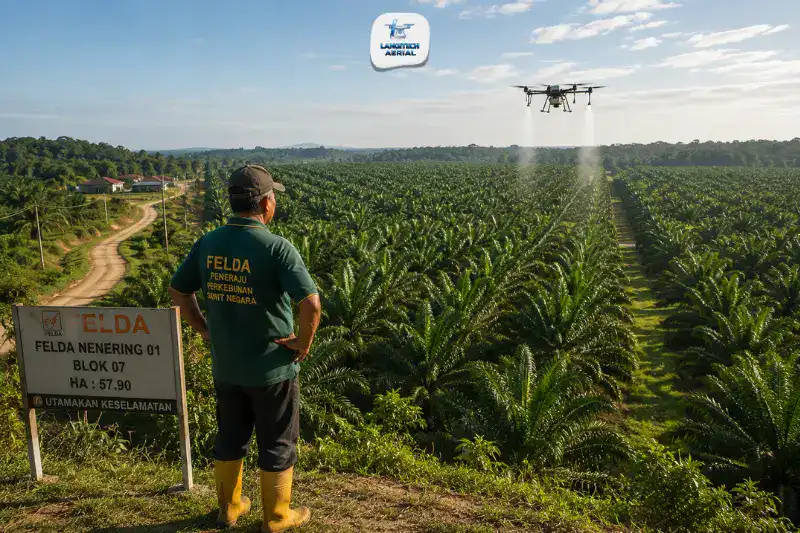
FELDA drone spraying is no longer an experiment. In fact, it already operates in FELDA schemes across Peninsular Malaysia. The government’s National Technology and Innovation Sandbox (NTIS) programme supports it, and FELDA’s own agricultural services division increasingly offers it. So settlers managing oil palm plots in Pahang, Johor, Sabah, and other scheme states now have practical access to a service that once reached only large estate groups. This guide covers how FELDA drone spraying works, why the organised block structure makes it more accessible than for dispersed smallholders, how to arrange it through official channels, and what CAAM compliance your provider must hold.
Key Takeaways
- FELDA drone spraying is already active. The NTIS programme selected FELDA Mempaga, Pahang as a drone and robotics sandbox, targeting settler income growth from RM3,017 to RM5,000 per month.
- The organised block layout of FELDA schemes gives settlers an advantage over dispersed independent smallholders. Because plots sit adjacent by design, they share drone deployment costs automatically.
- Access channels include FELDA’s agricultural services division, RISDA for eligible settlers, and direct engagement with CAAM-compliant providers.
- Every commercial operation requires CAAM RCoC-B plus Module 2 (AGR), a company UAWC, and an Agricultural ATF.
FELDA and Drone Technology: Where Malaysia Stands in 2026
The FELDA Mempaga Drone Sandbox
The Federal Land Development Authority (FELDA) manages roughly 850,000 hectares of oil palm across Malaysian schemes. That makes it one of the largest organised plantation land banks in the country. Settlers work individual plots of 10 to 15 hectares per family. Before technology intervention programmes, their income averaged RM3,017 per month.
Then the government selected FELDA’s Mempaga scheme in Pahang as a National Technology and Innovation Sandbox (NTIS) site under MOSTI. Five technology companies were deployed across 25 hectares of the estate. These were Poladrone, Aerodyne, Braintree Technologies, OFO Tech, and Nanoezinn. Together they tested drone, robotic, and AI solutions for harvesting, maintenance, and fertilisation. Specifically, the NTIS programme targets raising settler income to RM5,000 per month through technology adoption.
This government-backed programme confirms what commercial providers have already been demonstrating. In short, drone technology works in Malaysian oil palm schemes, it improves efficiency, and settlers can access it at practical scale.
Why Most Settlers Are Not Yet Using It
Adoption among FELDA settlers still lags behind the large estate groups, despite active programmes and proven technology. Research among settlers in Jengka, Pahang found two telling figures. First, 91% of respondents were unfamiliar with modern precision agriculture practices. Second, 54% believed new technologies would increase their management costs.
However, these findings reflect an information gap rather than resistance to technology. On plots above 5 hectares, drone spraying has a clearly favourable cost profile against manual spraying. Moreover, the labour shortage affecting all Malaysian oil palm operations hits settlers harder. After all, they cannot recruit and manage permanent spraying teams the way large groups can.
So the real barrier is knowledge and access. That means knowing the service exists, understanding what it costs, and knowing how to arrange it. This guide covers all three.
Why FELDA Block Structure Makes Drone Spraying More Accessible
Settlers hold one major advantage over independent smallholders, and it is the plot layout. FELDA schemes organise settler plots in structured blocks. As a result, adjacent plots already share access roads, drainage channels, and scheme infrastructure designed by FELDA’s development teams.
This structure creates natural grouping opportunities. By contrast, independent smallholders must arrange the same thing themselves by coordinating with neighbours. In a FELDA scheme, neighbouring settlers work plots that are contiguous by design. Therefore, multi-plot grouped deployments are straightforward to arrange, and per-hectare costs drop well below isolated plot visits.
Consider the scale. A FELDA field block of 20 to 30 adjacent settler plots represents 200 to 450 hectares of contiguous oil palm. That sits comfortably within the range where drone spraying economics are clearly favourable. At this scale, rates fall to RM 80 to RM 150 per hectare, which is comparable with the most cost-efficient manual programmes.
Furthermore, FELDA’s field officer network can coordinate block-level schedules across multiple neighbouring settlers. These are the same officers who already handle fertiliser delivery, harvesting logistics, and FFB evacuation. So the coordination infrastructure exists within schemes today. It simply needs applying to drone spraying planning.
Drone Spraying Applications for FELDA Settlers
Bagworm Control: The Most Urgent Application
Bagworm outbreaks, caused by Metisa plana and related species, are among the most economically damaging pest events in FELDA schemes. An uncontrolled outbreak can defoliate entire blocks within weeks. In turn, that cuts FFB yield by 30% to 50% in the following crop cycle.
Manual control requires workers to spray insecticide directly onto infested fronds at height. However, that is slow and labour-intensive. It rarely achieves full canopy coverage across a large block before the outbreak spreads further. Drone spraying instead delivers insecticide rapidly across entire blocks. As a result, it achieves the timely, comprehensive coverage that contains outbreaks before they compound.
Terra Drone Agri’s documented bagworm programme across Malaysian plantations confirms this. Specifically, drone application provides both greater coverage speed and more consistent application than manual methods on large-scale bagworm events.
Herbicide Programme: Inter-Row Weed Control
Inter-row weed management is a continuous cost in FELDA oil palm operations. It requires regular herbicide applications through the year. Manual teams cover roughly 1 to 2 hectares per worker per day in mature oil palm terrain.
Drone delivery covers 15 to 30 hectares per day, depending on platform and application rate. So consider a 15-hectare settler plot needing quarterly applications. Drone spraying cuts the annual application time from over 60 worker-days to just 4 to 8 deployment days. That is a fundamental labour substitution, and it addresses the core challenge of settler labour availability.
Fertiliser Foliar Application
Liquid foliar applications are increasingly part of FELDA nutrition programmes. This includes micronutrient boron, magnesium, and zinc supplementation. Drone delivery reaches the upper frond surfaces, where nutrient uptake is most efficient. By contrast, ground application mainly contacts the lower frond and stem base.
How to Access FELDA Drone Spraying
Through FELDA’s Agricultural Services Division
FELDA runs its own agricultural services structure of field officers, scheme managers, and central support teams. Together they coordinate inputs and services across scheme blocks. So contact your field officer or scheme manager to ask about drone spraying availability in your scheme. As these programmes become established within FELDA’s operational framework, scheme-level coordination is the most efficient route.
Through RISDA
Some settlers manage plots under RISDA (Rubber Industry Smallholders Development Authority) schemes that sit next to or overlap FELDA areas. Those settlers may qualify for RISDA’s mechanisation support programmes. RISDA runs separate channels from FELDA, so contact your RISDA district office for current availability.
Direct Engagement with a CAAM-Compliant Provider
Settlers can also engage a provider directly for an individual plot. Preferably, though, do it as a coordinated group with neighbouring settlers. When you engage directly, confirm the provider holds the full compliance stack. That means RCoC-B plus Module 2 (AGR), UAWC, and an Agricultural ATF for each deployment. For the full checklist, see our drone permit Malaysia requirements guide.
FELDA Drone Spraying Cost Guide
Costs differ significantly between individual plots and grouped scheme deployments.
| Plot Size / Arrangement | Estimated Cost (RM per ha) |
|---|---|
| Individual settler plot (under 15 ha) | RM 150 to RM 250 per ha |
| Grouped plots (3 to 5 settlers, 30 to 60 ha) | RM 100 to RM 180 per ha |
| Block-level programme (10+ settlers, 100+ ha) | RM 80 to RM 150 per ha |
| FELDA scheme-coordinated programme | Best rate, subject to scheme negotiation |
Chemical costs sit outside these rates, unless the provider includes chemical supply in the quote. So always clarify this before you compare providers.
For a detailed guide on drone spraying economics for smallholder and scheme operators, read our drone spraying smallholder Malaysia guide.
MSPO Certification Documentation for Settlers
Many settlers now participate in MSPO (Malaysian Sustainable Palm Oil) certification. Increasingly, it is a requirement for FFB supply chain compliance. For the audit, settlers need documented agrochemical management records.
Drone spraying operations produce a post-spray report for each deployment. It documents the product applied, area treated, dosage rate, pilot credentials, and CAAM permit reference. So these records satisfy the agrochemical management requirements under MSPO Part 2, the smallholder certification track.
Furthermore, FELDA’s group certification scheme lets individual settlers certify under a shared management system overseen by FELDA. As a result, scheme-level drone spraying records can support group MSPO certification across many settlers at once.
CAAM Compliance for FELDA Drone Spraying
Commercial operations need the same CAAM compliance as any other Malaysian agricultural drone programme:
- RCoC-B plus Module 2 (AGR): the pilot’s agricultural operations endorsement from CAAM
- UAWC: the Unmanned Aerial Work Certificate from CAAM for the operating company
- Agricultural ATF: submitted to drone.agr@caam.gov.my at least 14 working days before each deployment
The compliance obligation falls on the service provider, not on you as the settler. However, you are the landowner authorising the spraying. So always confirm your provider holds all three credentials before any operation begins.
Frequently Asked Questions
Is drone spraying available in all FELDA schemes across Malaysia?
Drone spraying is commercially available across Peninsular Malaysia. That includes in or near all the major scheme states: Pahang, Johor, Negeri Sembilan, Perak, Terengganu, and Kelantan. The NTIS sandbox at FELDA Mempaga, Pahang is the most advanced government-supported programme. However, commercial providers operate across all Peninsula Malaysia scheme areas. Contact LangiTech Aerial to confirm coverage for your specific scheme.
Will FELDA drone spraying increase or decrease my management costs?
For plots above 10 hectares, drone spraying usually reduces total costs for herbicide, pesticide, and foliar applications compared to manual labour contracting. This holds especially as daily-rated agricultural labour keeps rising across Malaysian oil palm regions. Moreover, the saving is largest when neighbouring settlers group their plots for block-level deployment. Then the provider’s mobilisation cost spreads across a larger combined area.
Can drone spraying increase my FFB yield?
It improves yield indirectly. Better chemical coverage, faster response to outbreaks like bagworm, and more consistent herbicide application all reduce weed competition for soil nutrients. Some plots have a history of incomplete or irregular manual spraying, particularly where worker access is difficult. On those, drone spraying often produces measurable yield improvement over 1 to 2 crop cycles, through more consistent weed and pest management.
Conclusion
FELDA drone spraying is moving from pilot programme to mainstream practice across Malaysian oil palm schemes. The NTIS sandbox at Mempaga, Pahang shows official commitment to adoption in the settler community. Meanwhile, the organised block structure of FELDA schemes makes grouped deployment easier and cheaper than it is for dispersed smallholders.
The practical steps are straightforward. First, contact your FELDA field officer about scheme-level programmes. Second, group with neighbouring settlers for better per-hectare rates. Third, confirm any provider you engage directly holds their full CAAM credentials before you authorise work on your plot.
LangiTech Aerial provides CAAM-compliant FELDA drone spraying services across Peninsula Malaysia scheme areas. This covers individual settler plots, grouped block programmes, and scheme-level coordination.
Contact LangiTech Aerial to talk through your FELDA scheme and get a drone spraying quote.
For a broader guide to smallholder drone spraying, read our drone spraying smallholder Malaysia guide.
Need Help Planning a Compliant Drone Project in Malaysia?
Speak with our team about commercial drone operations, compliance requirements, and the right aerial solution for your project.