
Agriculture Spraying
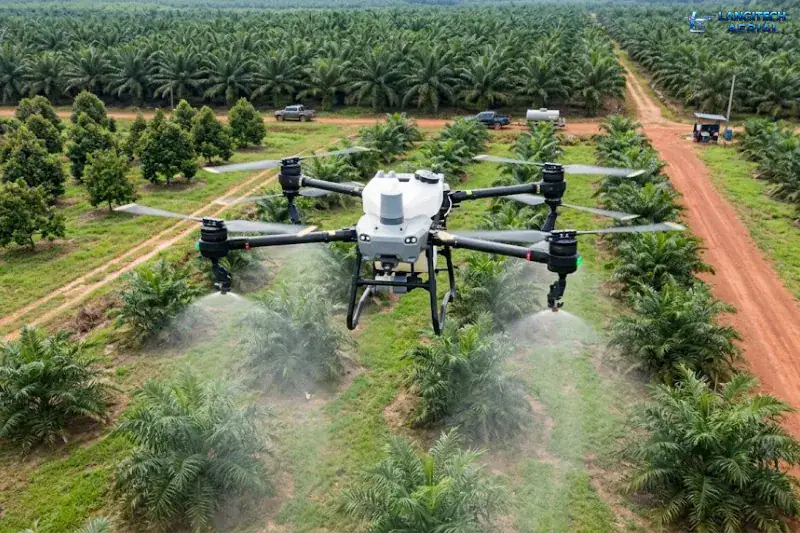
If you are evaluating agriculture drones for your plantation, the DJI Agras T50 Malaysia rollout is impossible to ignore. Currently, it is the top-tier offering from the world’s dominant commercial drone manufacturer. Consequently, operators across our oil palm, paddy, and durian sectors are adopting it rapidly.
However, this equipment requires a massive capital investment. Therefore, you need a clear-eyed look at what it actually delivers before you sign a purchase order.
The official DJI Agras T50 boasts a 40-liter tank, active phased array radar, and a massive 50kg spreading payload. Those are impressive headline numbers. But here is what they actually mean in brutal, real-world Malaysian plantation conditions.
Why the DJI Agras T50 Malaysia Dominates Estates
1. The Massive 40-Liter Tank Capacity
This is the single most operationally significant specification for large-scale Malaysian plantation work. The previous generation standard (the T30) only carried 30 liters.
The T50’s larger capacity means significantly fewer refill stops per flight. This directly translates to much higher effective coverage per hour. For oil palm spraying, a single T50 tank covers roughly 2 to 2.5 hectares. Over a full 8-hour workday, this extra capacity creates a massive operational advantage.
2. Dual Atomizing Nozzles and Centrifugal Spreader
The T50 combines liquid spraying and solid spreading capabilities in one single platform. The centrifugal disc spreader easily handles solid granular materials, like fertilizer pellets and rat baits. Furthermore, it boasts a massive spread width of up to 9 meters.
For estate managers who currently use separate ground tractors for fertilizer topdressing, this drone creates incredible operational efficiency. However, you must test your specific solid fertilizer first. Malaysia’s extreme humidity causes some cheaper materials to clump and bridge inside the hopper.
3. Active Phased Array Radar
The T50 carries a powerful forward-looking radar. This system provides critical obstacle detection in conditions where standard cameras fail completely.
For example, early morning flights over Malaysian estates often face heavy ground mist. Furthermore, open burning on neighboring plots creates thick smoke. The radar pushes through all of this. Additionally, it allows the drone to precisely follow the uneven terrain of hilly estates in Pahang, Sabah, and Sarawak.
Real-World Performance vs. Brochure Hype
DJI’s marketing brochure claims a theoretical maximum coverage rate of 21 hectares per hour. You will almost never hit that number in Malaysia.
In actual plantation operations, you must account for terrible estate roads, varying canopy heights, wind conditions, and pilot fatigue. Therefore, a realistic effective coverage rate sits between 8 to 14 hectares per hour.
Honestly, that is still a phenomenal capability step above previous drones. Consider a 500-hectare estate facing a sudden pest outbreak. You only have a 5-day window to treat it. A T50-equipped team will finish that job easily, whereas an older T30 team will likely fail.
True Costs and Business ROI
In Malaysia, distributors currently price the DJI Agras T50 between RM65,000 and RM80,000. This depends heavily on whether you buy the smart charging hub, the advanced controller, and spare batteries.
However, that price only covers the drone. To run a highly productive operation, you absolutely need spare battery sets. Additionally, you must buy a heavy-duty field support vehicle with a large water tank.
For a commercial service operator charging RM35 to RM50 per acre, the math usually makes sense. If you maintain a busy schedule, this drone typically pays for itself within 18 to 30 months.
Two Alternatives Worth Considering
The T50 is absolutely best-in-class for large-scale work. However, it is not your only choice.
First, the DJI Agras T40 remains incredibly capable. It features a smaller 30-liter tank but comes at a much lower price point. For small estates under 200 acres, the T40 often makes better financial sense. Second, the XAG P100 Pro offers comparable capacity and uses a completely different control architecture. It is definitely worth evaluating if you are building a massive multi-drone fleet.
Need Help Planning a Compliant Drone Project in Malaysia?
Speak with our team about commercial drone operations, compliance requirements, and the right aerial solution for your project.