
High-Rise Cleaning
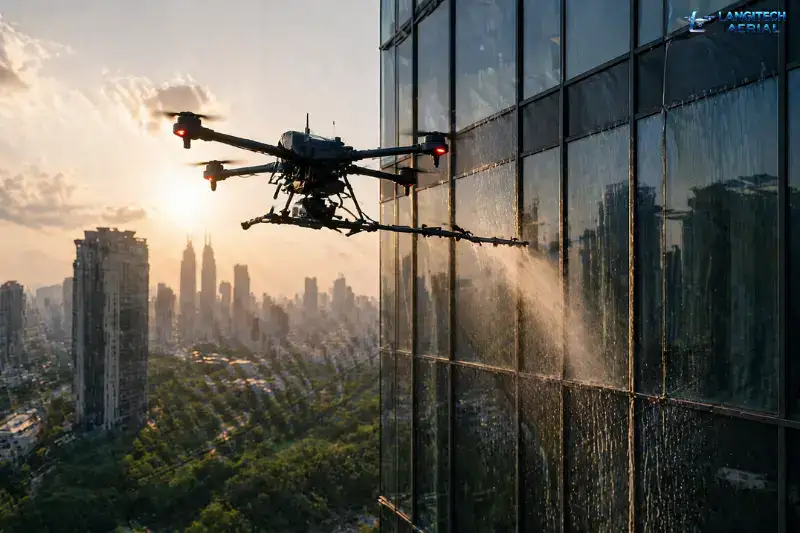
Drone cleaning Malaysia services are transforming how building owners and facilities managers maintain their properties. Instead of scaffolding or rope access teams working at dangerous heights, a professional drone handles the job from the air. It works faster, keeps workers safely on the ground, and produces full CAAM compliance documentation. This guide covers everything you need to know before engaging a provider.
Key Takeaways
- Drone cleaning Malaysia replaces scaffolding, gondolas, and rope access — with no personnel working at height
- Malaysia’s tropical climate accelerates biological growth on building exteriors, so regular cleaning is essential rather than cosmetic
- Solar panels lose 15% to 30% of energy output when heavily soiled — drone cleaning directly recovers that yield
- A CAAM-compliant provider must hold RCoC-certified pilots, carry public liability insurance, and deliver documented SOPs for every job
What Is Drone Cleaning Malaysia and How Does It Work?
Drone cleaning Malaysia operations use unmanned aerial vehicles fitted with a pressurised water system. They clean exterior building surfaces, solar arrays, and other hard-to-access structures — without putting any worker at height.
Standard inspection drones only observe. Cleaning drones, however, are working machines. They carry either an onboard water tank or connect via hose to a ground-based pump. From there, they deliver a controlled soft-wash flow to the target surface while hovering at a precise, programmed distance.
How Drone Cleaning Malaysia Soft-Wash Systems Operate
Most professional drone cleaning systems use a soft-wash approach. A low-to-medium pressure water flow — often mixed with a mild biodegradable detergent — covers the surface uniformly. The drone maintains a consistent standoff distance of 1 to 3 metres using onboard sensors and GPS stabilisation. As a result, the spray is even and controlled, without the localised high-pressure impact that damages coatings or seals.
Tank-Based vs Hose-Fed Drone Cleaning Systems
Two main configurations are in use today:
Battery + Tank (onboard water supply): The drone carries its own water tank for full spatial freedom. This works best for solar panel cleaning and smaller rooftop areas. Operators plan flight cycles around tank capacity.
Battery + Hose (ground-connected supply): The drone connects to a ground-based pump via a lightweight hose, providing unlimited water supply. This is therefore the standard approach for high-rise facade drone cleaning Malaysia jobs, where large continuous surfaces need sustained coverage. The ground team manages the pump while the drone navigates the facade above.
What Surfaces Are Suitable for Drone Cleaning in Malaysia
Drone cleaning works well on glass curtain walls, coated aluminium and composite cladding, concrete and stone exteriors, solar photovoltaic panels, and painted industrial rooftops.
Some surfaces, however, need extra care. Very old render with loose material, fragile historical stonework, and panels with damaged anti-reflective coatings all require a pre-job surface assessment. As such, a reputable provider will conduct this before any deployment. If they do not ask about your surface type, treat that as a warning sign.
Why Malaysian Buildings Need Regular Drone Cleaning
This is not simply a cosmetic issue. In Malaysia’s climate, deferred exterior maintenance carries real structural, financial, and operational consequences.
Humidity, Pollution, and Biological Growth in Malaysia
According to MetMalaysia, Malaysia’s average relative humidity sits between 70% and 90% year-round. Combined with high temperatures, regular rainfall, and urban air pollution, these conditions create near-perfect conditions for algae, moss, mildew, and biofilm to grow on building exteriors.
On glass facades, this growth forms a stubborn film that rain alone cannot remove. Solar panels suffer a different but equally serious problem — biological buildup directly blocks light absorption. Meanwhile, on concrete and cladding, trapped moisture accelerates micro-fracturing over time.
Furthermore, coastal buildings in Penang, Port Klang, and Johor Bahru face additional salt deposition. Buildings in the Klang Valley, by contrast, deal with a persistent layer of vehicle emissions and construction dust.
The Cost of Neglecting Drone Cleaning in Malaysia
Beyond appearance, facade neglect creates practical and legal problems.
Strata obligations: Under the Strata Management Act 2013, management bodies must maintain common property in good repair. A deteriorated facade can therefore trigger disputes, audits, and liability claims.
Warranty risks: Many facade systems carry manufacturer warranties that require regular cleaning to stay valid. Neglecting this voids those warranties — and consequently, the repair costs that follow are far larger than a regular cleaning programme.
Tenant expectations: For commercial properties, a poorly maintained facade signals operational neglect. As a result, it affects tenant retention, rental rates, and overall asset value.
Why Solar Panel Soiling Makes Drone Cleaning Malaysia Essential
For solar asset owners, this is the most financially direct argument for regular drone cleaning Malaysia services.
Research and operational data consistently show output losses of 15% to 30% on uncleaned panels in Malaysia’s climate. For a 100kWp rooftop installation generating approximately RM 45,000 to RM 60,000 annually, a 20% output loss means RM 9,000 to RM 12,000 in unrealised energy every year. In contrast, a single drone cleaning cycle costs far less — and restores output immediately.
For a full breakdown on solar panel drone cleaning, read our solar panel drone cleaning Malaysia guide.
Drone Cleaning Malaysia vs Traditional Cleaning Methods
Drone Cleaning Malaysia vs Rope Access and Abseiling
Rope access requires trained workers to descend a building facade using rigging and harnesses. Teams need significant setup time, and workers face active safety risks at height throughout the job.
Drone cleaning Malaysia, however, removes the need for anyone to leave the ground. For buildings above 20 storeys — increasingly the norm across KL, Cyberjaya, and Johor Bahru — this shift significantly lowers the operational risk profile. Additionally, rope access struggles on large facades, windy days, and buildings with irregular architecture. Drone systems handle all of these with programmed precision.
Drone Cleaning Malaysia vs Gondola and Scaffold Platforms
Gondola (BMU) systems move horizontally across a building facade. They work, but they are expensive. Equipment mobilisation, specialist operators, and tight scheduling windows all add cost. Moreover, if a building has no permanent BMU system, temporary scaffolding is even more disruptive. Drone cleaning, therefore, bypasses this infrastructure entirely.
Drone Cleaning Malaysia vs Manual Ground Crews
Ground crews with ladders and pressure washers are still common for low-rise work. Above four storeys, however, ladder work becomes unsafe and slow. For rooftop solar arrays specifically, walking across fragile panel surfaces risks the very damage that drone cleaning avoids.
Side-by-Side Comparison
| Method | Safety Risk | Speed | Cost (Relative) | Suitable for High-Rise? |
|---|---|---|---|---|
| Rope access | High (personnel at height) | Moderate | Medium–High | Yes, with constraints |
| Gondola / BMU | Medium | Moderate | High | Yes, if installed |
| Scaffold | Medium | Slow | High | Restricted by height |
| Ground crew | Low–Medium | Slow | Low–Medium | No |
| Drone cleaning | Low (no one at height) | Fast | Medium | Yes |
Applications of Drone Cleaning Malaysia Services
High-Rise Facades and Glass Curtain Walls
This is the most visible application and the one most building managers encounter first. Drone cleaning suits the glass and aluminium curtain-wall towers that define Malaysia’s skylines — from KLCC to KL Eco City, and from Putrajaya to Iskandar Puteri.
A professional operation follows a pre-programmed flight path, cleaning section by section. Meanwhile, the ground team monitors the pump and maintains visual contact. The operator then delivers timestamped footage and before/after photo records as part of the job package.
For a dedicated guide on facade cleaning, read our building facade cleaning drone Malaysia guide.
Solar Panel Drone Cleaning Malaysia — Rooftop and Ground-Mounted
Malaysia’s solar capacity has expanded rapidly under the National Energy Transition Roadmap. As a result, the number of panels needing regular maintenance across rooftops, industrial facilities, and ground-mounted farms in Kedah, Terengganu, and Johor has grown substantially.
Drone cleaning Malaysia is the only practical option for large rooftop arrays where walking on panels is unsafe and manual cleaning is too slow. Furthermore, for ground-mounted farms, drone systems cover hundreds of panels per session. This keeps output near its designed rating year-round.
Industrial Rooftops and Inaccessible Structures
For facilities managers in Penang’s industrial corridors, Selangor’s manufacturing clusters, or Johor’s logistics parks, drone cleaning offers a practical solution. It maintains large-footprint assets without shutting down operations or mobilising heavy equipment. In other words, the facility keeps running while the cleaning gets done.
Architectural Features and Cladding
Drone cleaning also works for outdoor structures where conventional access is impractical. This includes large signage, architectural canopies, heritage facades where scaffolding contact is undesirable, and venue exteriors with complex shapes that make ground access difficult.
CAAM Compliance for Drone Cleaning Malaysia Operations
This is the section most building managers overlook. It is also the one that separates a professional provider from an uninsured operator flying without approval.
CAAM Permits Required for Drone Cleaning Malaysia
CAAM governs all commercial drone operations in Malaysia under the Civil Aviation Regulations 2016 (Part XVI). This includes drone cleaning Malaysia operations without exception.
For a standard deployment in a non-restricted area, the provider needs an Authorisation to Fly (ATF) permit. They must apply at least 14 working days before the flight date. For operations near airports, government buildings, or in controlled airspace — including central KL — additional agency coordination applies and lead times are consequently longer.
Why RCoC-Certified Pilots Matter for Drone Cleaning Malaysia
The Remote Pilot Certificate of Competency — Basic (RCoC-B) is CAAM’s certification for commercial drone pilots. This certification gives you assurance that the pilot near your property holds official approval from Malaysia’s aviation authority.
Any drone cleaning Malaysia provider without RCoC-certified pilots is not compliant. Furthermore, any incident involving their drone creates a liability dispute — one that may fall partly on you for engaging them.
For a full breakdown of Malaysia’s drone regulations, read our CAAM drone regulations Malaysia guide.
Insurance and Liability
A compliant provider carries public liability insurance for their drone operations. Before engaging anyone, request written confirmation of their coverage. Ask specifically whether it covers operations at your building’s height and location.
Five Questions to Ask Any Drone Cleaning Provider
- Are your pilots RCoC-certified and do you hold a current ATF for this work?
- Can you provide a certificate of public liability insurance for drone cleaning?
- What permits will you obtain before the clean begins?
- What documentation do you deliver after the job?
- Have you previously cleaned buildings of this height and surface type?
A provider who cannot answer all five clearly is not ready for a commercial deployment on your asset.
How to Evaluate a Drone Cleaning Malaysia Provider
Drone Cleaning Malaysia Equipment and Payload Capacity
For buildings above 20 storeys, the drone must be rated for that operating height. Generic agriculture spray drones, for instance, are not suitable for high-rise facade work. Therefore, ask your provider specifically what equipment they plan to deploy and why it suits your building.
Credentials and Deployment History
Beyond the RCoC-B, experienced providers hold CAAM operational records from active commercial deployments. Ask for evidence of previous comparable projects — ideally with documentation or imagery you can review.
What Drone Cleaning Malaysia Deliverables Should Include
After a professional drone cleaning Malaysia session, you should receive:
- Pre-clean and post-clean photographic documentation
- An operations log with date, time, area covered, and operator details
- ATF permit documentation confirming the flight was authorised
- Safety records suitable for your building management file
This matters for strata compliance, insurance records, and warranty maintenance requirements.
Red Flags to Watch For
Watch out for providers who cannot mention CAAM permits when you ask, cannot produce pilot certification, quote significantly below market rate without explanation, offer no post-job reporting process, or skip the site assessment before quoting. These are all signs of an unqualified operator.
Drone Cleaning Malaysia Cost Factors
What Drives the Price of Drone Cleaning in Malaysia
Height: Operations above 40 storeys require higher-spec drones and more complex CAAM approvals. Both factors increase cost.
Surface area: Most drone cleaning Malaysia providers price by total square metres. However, larger areas typically attract a lower per-square-metre rate.
Surface type: Glass cleans more easily than biofilm-heavy concrete. Heavily soiled surfaces may need a pre-treatment step, which adds time and cost.
Location: Buildings in restricted airspace — inner KL, near airports, or near government compounds — require additional CAAM coordination. This extends pre-flight lead times and adds administrative cost.
Frequency: Ongoing contracts, such as quarterly or semi-annual programmes, are generally priced more favourably than one-off cleans.
How to Get an Accurate Drone Cleaning Quote
Before contacting a provider, prepare the following:
- Building address and approximate height (floors or metres)
- Estimated total facade area or solar array size
- Surface material (glass, concrete, composite cladding, or panel type)
- Date of last cleaning and current surface condition
- Whether you need CAAM documentation as part of the deliverable
ROI: Drone Cleaning Malaysia vs Traditional Methods
For building owners moving away from gondola or rope access cleaning, drone cleaning Malaysia typically offers a better total cost of engagement. Gondola mobilisation alone adds significant cost before any cleaning occurs.
For solar panel owners, the ROI case is even clearer. Restored energy output is usually recovered within one or two billing cycles after the clean. Consequently, the financial case for a regular programme almost always stacks up.
Frequently Asked Questions
Is drone cleaning safe for glass and coated surfaces?
Yes — when a trained professional uses the correct equipment. Soft-wash systems deliver low-to-medium pressure water flow, which is safe for glass, coated aluminium, and most standard facade materials. If your facade has specialist coatings or ageing materials, inform the provider during the assessment stage so they can adjust their approach accordingly.
How long does it take to clean a high-rise building?
It depends on height, total facade area, and degree of soiling. A mid-rise building of 15 to 25 storeys with a moderately soiled glass facade might take one to three days. A taller tower or heavily soiled surface will take longer. Therefore, your provider should give you a clear timeline after the site assessment.
Do I need to shut down solar panels during cleaning?
In most cases, no. Most soft-wash drone operations proceed with the system live. However, consult both your provider and your solar installer before the first clean — particularly for ground-mounted farm systems with complex inverter setups.
How often should I schedule drone cleaning in Malaysia?
For commercial building facades, a semi-annual programme is the minimum. Coastal buildings and those in high-pollution areas may benefit from quarterly cleans. Similarly, for solar panels, quarterly cleaning is the recommended standard given Malaysia’s humidity and dust conditions.
Does the contractor need CAAM permits for cleaning operations?
Yes. According to CAAM, all commercial drone operations in Malaysia — including cleaning — require authorisation. Your provider must hold an ATF permit for each deployment and employ RCoC-certified pilots. Always request permit documentation before work begins.
Conclusion
For Malaysian building owners, facilities managers, and solar asset operators, drone cleaning Malaysia services represent a genuine shift in how exterior maintenance gets done. They remove personnel from height, cover surfaces faster than manual methods, and deliver documented results that matter for compliance, warranties, and operational records.
The key, therefore, is choosing a provider who works within Malaysia’s CAAM framework — with certified pilots, proper authorisation, and a professional documentation process.
If you manage a commercial building, industrial facility, or solar installation in Malaysia, contact LangiTech Aerial for a site assessment and quote.
Need Help Planning a Compliant Drone Project in Malaysia?
Speak with our team about commercial drone operations, compliance requirements, and the right aerial solution for your project.