
Industry News
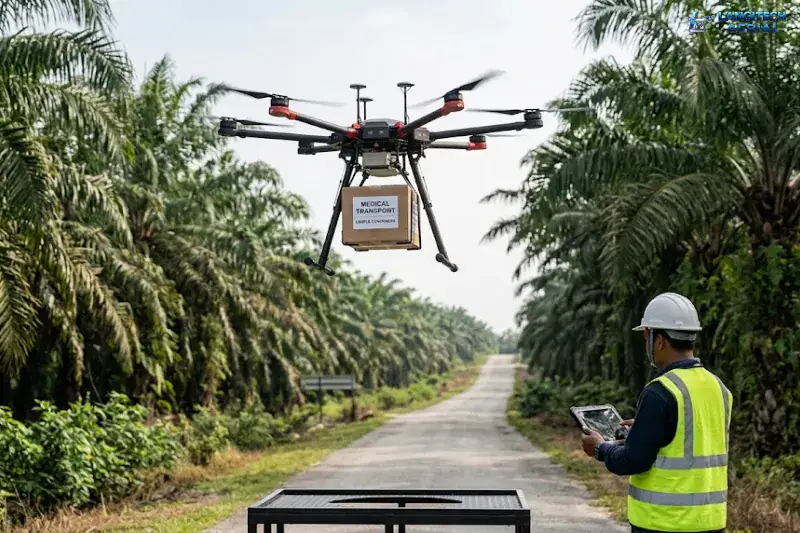
Few topics generate more excitement and confusion than drone delivery. The concept sounds compelling. Packages fly straight to your doorstep and bypass road congestion entirely. However, the reality in 2026 is more nuanced.
Commercial aerial delivery is growing. But operators concentrate on the specific use cases where drones genuinely beat conventional logistics. So do not expect across-the-board consumer parcel delivery yet.
Industry analysts project that the unmanned logistics market will grow from USD 2.6 billion in 2025 to USD 13.4 billion by 2031. That is a large number. However, it covers the entire scope of operations, from warehouse inventory scanning to rural medical drops. So if you are evaluating aerial logistics for your business, you need to know what is actually operational today.
Where Drone Delivery Is Actually Working
1. Medical and Healthcare Logistics
The strongest case for aerial logistics is not e-commerce. It is healthcare delivery in remote areas. Getting blood samples, vaccines, and critical medications to rural clinics in Sabah, Sarawak, and the interior of Peninsular Malaysia is difficult. Poor road conditions make conventional transport slow and unreliable.
Drones remove that infrastructure constraint. Several pilot programmes already run in Borneo, turning a half-day truck journey over unpaved roads into a 30-minute flight. In this application, the model is operationally proven.
2. Industrial and Plantation Operations
Inside large plantation estates and heavy industrial facilities, drone logistics is expanding. For example, moving a soil sample from a remote block to the agronomist’s office takes hours by truck. A drone does it in minutes. Similarly, delivering a replacement part to a remote pump station solves a real logistical problem. Because these flights happen in private airspace, they avoid the complex urban regulations entirely.
3. E-Commerce Pilots
Several local logistics companies run e-commerce drone pilots. They focus on last-mile delivery in lower-density suburban and semi-rural areas. Specifically, they target lightweight parcels under three kilograms. There, the speed advantage can justify the operational complexity. However, as of 2026 these remain pilots rather than full commercial rollouts.
What the CAAM Regulations Currently Allow
Under the Civil Aviation Authority of Malaysia (CAAM) 2025 regulatory framework, commercial delivery remains tightly controlled. You need an Authorisation to Fly (ATF) permit for every flight. Furthermore, any meaningful delivery route requires Beyond Visual Line of Sight (BVLOS) capability. In turn, BVLOS flights need specific advanced authorisations.
CAAM is currently developing the BVLOS framework through the UAS-TMS rollout. What does that mean in practice? Aerial delivery is commercially viable only where BVLOS authorisation is realistically achievable. So rural areas with defined point-to-point routes work well. Dense urban residential delivery does not.
Five Rules for a Good Delivery Use Case
If you want to implement drone delivery logistics today, your use case should meet these five criteria:
- Time-sensitive: The payload needs speed, such as medical samples or urgent parts, that justifies the premium cost.
- Infrastructure barriers: Conventional logistics must face genuine hurdles, such as river crossings, poor roads, or ferry dependencies.
- Managed airspace: The route should sit within a controlled environment, like a plantation, industrial estate, or defined flight corridor.
- Lightweight payloads: The cargo must weigh under five kilograms, since current commercial platforms are optimised for this range.
- Predictable routes: The regulatory setup cost only makes sense for repeating daily routes, not one-off deliveries.
The 2026 Outlook
Full-scale urban consumer delivery in Malaysian cities is not imminent. The regulatory framework, air traffic management, and public acceptance all need years more development. So if someone promises to fly a coffee to your KL apartment tomorrow, they are ahead of the regulatory reality.
However, rural deliveries, industrial logistics, and high-value cargo transport are real and growing. These use cases solve genuine infrastructure problems today.
Need Help Planning a Compliant Drone Project in Malaysia?
Speak with our team about commercial drone operations, compliance requirements, and the right aerial solution for your project.