
Agriculture Spraying
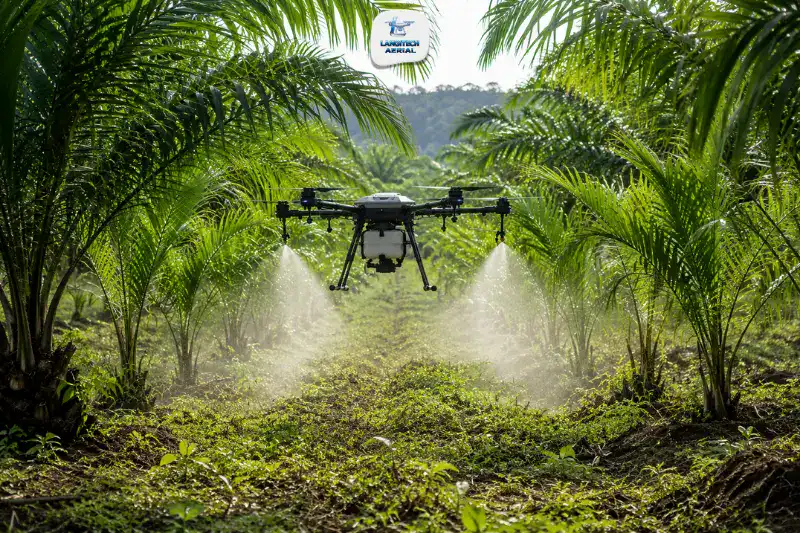
Drone herbicide Malaysia is becoming the standard weed management tool on oil palm estates, paddy farms, and rubber plantations across the country. Weed competition is one of the most direct causes of yield loss in Malaysian plantations — yet manual herbicide application is slow, inconsistent, and exposes workers to direct chemical contact throughout the operation. Drone delivery solves all three problems simultaneously. This guide covers how drone herbicide Malaysia works, which weed species it targets, when to use pre-emergence versus post-emergence applications, and how to integrate aerial herbicide delivery into a responsible weed management programme.
Key Takeaways
- Drone herbicide Malaysia covers oil palm, paddy, rubber, and other commercial crops — one drone covers 15 to 40 hectares per day versus 1 to 3 hectares per manual sprayer
- Pre-emergence herbicide prevents weed germination; post-emergence herbicide targets established weeds — both are applicable via drone with different nozzle configurations
- Weed pressure mapping combined with drone herbicide delivery reduces total herbicide usage by 20% to 40% through zone-based targeted treatment
- All commercial drone herbicide operations in Malaysia require CAAM RCoC-B + Module 2 (AGR) certification and a UAWC from the operating company
Why Weed Management Matters on Malaysian Plantations
Weed competition is a persistent and costly problem across Malaysia’s plantation crops. On oil palm estates, weeds compete directly with palms for soil nutrients, moisture, and light — reducing yield potential and forcing higher fertiliser inputs to compensate for soil nutrient depletion. Research consistently shows weed competition reducing oil palm yields by 15% to 30% in unmanaged blocks, particularly during the immature phase when palms are most vulnerable.
On paddy farms, weed pressure during tillering and vegetative stages directly reduces grain fill and yield. Furthermore, some paddy weeds — particularly barnyard grass (Echinochloa crus-galli) and weedy rice — develop herbicide resistance when the same chemistry is applied repeatedly via the same delivery method. Drone herbicide Malaysia, by contrast, enables rotation of application methods and formulations in ways that ground equipment cannot practically achieve in flooded field conditions.
On rubber estates, ground cover weeds compete for soil nutrients and harbour pests. Regular herbicide management in inter-rows maintains a clean floor that supports tapping operations and reduces snake habitat — an often-overlooked practical benefit on Malaysian rubber estates.
Common Weeds Targeted by Drone Herbicide Malaysia
Understanding which weeds you are managing determines which herbicide chemistry and application timing is appropriate. The most economically significant weed species on Malaysian plantation crops include:
Oil Palm Weeds
- Mikania micrantha (mile-a-minute vine) — one of the most aggressive climbing weeds in Malaysian oil palm, capable of blanketing immature palms and blocking sunlight. Pre-emergence herbicide prevents establishment; post-emergence treatment with systemic herbicides targets established vines
- Asystasia gangetica (Chinese violet) — broadleaf perennial common in inter-rows, competes for soil nutrients
- Paspalum conjugatum (buffalo grass) — dense ground cover grass species, tolerant of shade
- Nephrolepis biserrata (Boston fern) — dominant fern species on many Peninsular Malaysia estates, particularly after land clearing
Paddy Weeds
- Echinochloa crus-galli (barnyard grass) — the most yield-damaging weed in Malaysian paddy, requiring precise early-stage post-emergence herbicide timing
- Monochoria vaginalis (pickerelweed) — aquatic broadleaf weed common in MUDA and KADA scheme paddy fields
- Weedy rice (Oryza sativa f. spontanea) — genetically related to cultivated rice, making selective control challenging
Rubber Weeds
- Ground cover grasses and broadleaf species in inter-rows — managed with contact or systemic post-emergence herbicides to maintain clean tapping conditions
Pre-Emergence vs Post-Emergence Drone Herbicide Malaysia
This is the distinction most guides skip over — but it fundamentally changes both the application timing and the nozzle configuration required.
Pre-Emergence Herbicide by Drone
Pre-emergence herbicides are applied to bare or recently cleared soil before weed seeds germinate. The active ingredient forms a chemical barrier in the upper soil layer that prevents germination. Consequently, timing is critical — the herbicide must be applied within 3 to 5 days of soil disturbance or land preparation, before target weeds emerge.
For drone herbicide Malaysia pre-emergence applications:
- Flat fan nozzles deliver broad, uniform soil coverage with minimal drift
- Medium-to-large droplet sizes reduce volatilisation loss
- Application immediately after land preparation or inter-row cultivation gives best results
Common pre-emergence active ingredients used in Malaysian plantation herbicide programmes include oxyfluorfen and pendimethalin — always verify against the current DOA Malaysia approved pesticide list for aerial application before use.
Post-Emergence Herbicide by Drone
Post-emergence herbicides target actively growing weeds that have already germinated. They fall into two categories:
Contact herbicides — kill only the plant tissue they directly contact. Fast-acting and visible results within days. However, they do not translocate to roots, so regrowth from established root systems can occur. Paraquat is the most widely used contact herbicide in Malaysian plantations, though restrictions on its use are increasing under sustainability certification frameworks.
Systemic herbicides — absorbed by foliage and translocated through the plant to roots and growing points, killing the entire plant including the root system. Glyphosate is the most widely used systemic herbicide in Malaysian plantation inter-row management. Notably, systemic herbicides require the weed to be actively growing for maximum uptake — application during stress periods (drought, waterlogging) reduces efficacy.
For drone herbicide Malaysia post-emergence applications:
- Fine-to-medium droplet nozzles improve foliar coverage and uptake on broadleaf targets
- Hollow cone or flat fan nozzles depending on weed canopy structure
- Rotary atomiser configurations reduce drift in inter-row applications
Weed Pressure Mapping and Targeted Drone Herbicide Malaysia
The highest-value approach to drone herbicide Malaysia combines two drone services: a pre-application weed pressure survey and targeted drone herbicide delivery.
Step 1 — Weed pressure mapping: The drone captures high-resolution aerial imagery or multispectral data across the estate. The processing team identifies blocks and zones with high weed density based on canopy cover and spectral signatures. A weed pressure map then grades each zone by treatment priority.
Step 2 — Variable-rate treatment plan: Rather than applying herbicide uniformly across the entire estate, treatment zones receive doses proportional to their weed pressure level. High-density zones receive full-rate applications; low-density or recently treated zones receive reduced rates or are skipped entirely.
Step 3 — Targeted drone herbicide delivery: The spraying drone executes the treatment plan, applying the programmed rate to each zone as it flies the flight path.
This approach reduces total herbicide consumption by 20% to 40% compared to blanket application across the entire estate. Moreover, it reduces the total chemical load in the soil and drainage channels — directly supporting MPOB best practice guidelines and MSPO/RSPO responsible chemical use requirements.
For a guide to multispectral mapping for weed detection, read our multispectral mapping Malaysia guide.
Crown Spray vs Wide Spray Configuration
This is the technical distinction that determines whether the herbicide hits the target weeds or damages the crop.
Crown spray directs the spray downward, in a narrow cone pattern centred on the palm inter-row between palms. This configuration targets ground-level weeds while avoiding spray contact with palm fronds. Crown spray is the standard configuration for drone herbicide Malaysia on mature oil palm inter-row treatment.
Wide spray delivers a broader spray pattern across a wider swath — appropriate for paddy fields, vegetable farms, and open ground crops where the entire surface area needs treatment and there is no tall-standing crop to protect. Furthermore, wide spray achieves higher coverage rates per flight hour on flat, open terrain.
Your drone herbicide Malaysia provider should specify which configuration they plan to deploy for your crop type. A provider who applies wide spray on mature oil palm without crown spray adjustment risks crop damage and uneven ground-level coverage.
Drone Herbicide Malaysia vs Manual Backpack Spraying
| Factor | Manual Backpack Spraying | Drone Herbicide Malaysia |
|---|---|---|
| Coverage per day | 1–3 ha per worker | 15–40 ha per drone |
| Chemical drift risk | High — wind exposure at ground level | Lower — controlled droplet size and height |
| Worker chemical exposure | High — direct contact throughout | Minimal — operator at safe distance |
| Inter-row access | Limited on steep or waterlogged terrain | Unrestricted — flies above terrain |
| Application consistency | Variable | Uniform — programmed parameters |
| Drainage channel risk | High — manual overspray near drains | Lower — targeted zones defined in flight plan |
| Documentation | Manual records | Digital flight log and GPS coverage map |
The chemical drift comparison is particularly relevant on Malaysian oil palm estates adjacent to drainage channels, water bodies, and neighbouring small farms. Manual spraying by backpack in wind conditions creates significant drift risk that is difficult to control. Drone herbicide Malaysia, by contrast, applies at a defined height with specified droplet size — reducing drift risk and protecting adjacent vegetation and water quality.
CAAM Compliance for Drone Herbicide Malaysia
All commercial drone herbicide Malaysia operations fall under CAAM’s agricultural operations framework and require:
- RCoC-B + Module 2 (AGR) — pilot must hold agricultural module endorsement
- UAWC — the operating company must hold the Unmanned Aerial Work Certificate
- ATF (Agricultural) — submitted to drone.agr@caam.gov.my at least 14 working days before deployment
Additionally, the herbicide formulation used must appear on the DOA Malaysia approved pesticide list for aerial application. Not all ground-registered herbicides are cleared for aerial delivery — confirm this with your provider before the programme begins.
For a complete compliance guide, read our CAAM drone regulations Malaysia guide.
Frequently Asked Questions
Can drones apply all types of herbicide in Malaysia?
Not all ground-registered herbicides are cleared for aerial drone application in Malaysia. The Department of Agriculture (DOA) Malaysia maintains an approved pesticide list for aerial application. Before any drone herbicide Malaysia programme begins, the formulation must be verified against this list. Contact DOA Malaysia at www.doa.gov.my or ask your drone provider to confirm the specific products they plan to use are cleared for aerial delivery.
What is the difference between pre-emergence and post-emergence drone herbicide?
Pre-emergence herbicide targets weed seeds before they germinate — applied to bare soil within 3 to 5 days of land preparation. Post-emergence herbicide targets weeds that are already growing — either as contact products that kill foliage on contact, or systemic products that translocate to roots. The choice depends on your weed population, growth stage, and crop protection requirements. Your drone provider should recommend the appropriate type based on a site assessment.
How does drone herbicide Malaysia affect soil health compared to manual methods?
Drone delivery generally results in lower total herbicide usage per hectare compared to manual methods due to more precise targeting and controlled application rates. Furthermore, drone application eliminates the ground compaction caused by tractor-based spraying equipment — a particular benefit on oil palm inter-rows where soil structure directly affects root development and nutrient uptake. Documenting reduced chemical usage supports MSPO and RSPO responsible chemical management requirements.
How many hectares can a drone treat per day for herbicide in Malaysia?
Coverage depends on the terrain, crop type, and herbicide application rate. On oil palm estates with crown spray configuration, a DJI Agras T50 typically treats 15 to 30 hectares of inter-row per day. On flat paddy fields with wide spray configuration, daily coverage can reach 30 to 50 hectares. Your provider should give a site-specific estimate after assessing your terrain and block layout.
Conclusion
Drone herbicide Malaysia gives estate managers a faster, more consistent, and better-documented approach to weed control than manual backpack spraying can deliver. It reduces worker chemical exposure, targets treatment precisely to high-pressure zones, and produces the application records that MSPO and RSPO programmes require.
The greatest value comes from combining weed pressure mapping with targeted drone delivery — treating only where the pressure justifies it, at the right timing for the weed growth stage, with the right herbicide chemistry for your specific weed population.
LangiTech Aerial provides CAAM-compliant drone herbicide Malaysia services across Peninsula Malaysia for oil palm, paddy, rubber, and other commercial crops.
Contact LangiTech Aerial to discuss your weed management programme and get a site-specific quote.
For a broader overview of our agriculture drone services, read our drone crop spraying Malaysia guide.
Need Help Planning a Compliant Drone Project in Malaysia?
Speak with our team about commercial drone operations, compliance requirements, and the right aerial solution for your project.