
Agriculture Spraying
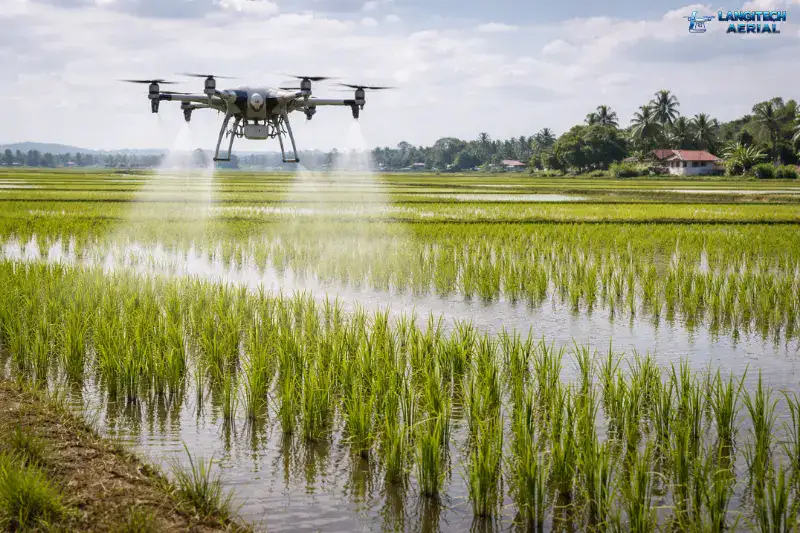
If you farm rice in Malaysia’s major irrigation schemes, you have probably noticed a massive shift. Specifically, whether you are in MADA (Kedah and Perlis) or KADA (Kelantan), drones are flying over neighboring plots every single season. This is definitely not a coincidence.
Both irrigation authorities actively support new agricultural drone services. They want to solve a problem that grows worse every year: severe labor shortages. You simply cannot find reliable manual workers during the extremely tight windows that paddy cultivation demands.
Therefore, drone paddy farming Malaysia services are quickly becoming the new operational standard. This guide explains exactly how commercial drones handle Malaysian paddy conditions, what they actually cost, and what you must ask an operator before hiring them.
Why Drone Paddy Farming Malaysia is the Perfect Fit
Several unique characteristics of Malaysian paddy cultivation make drone spraying an absolute necessity.
1. Bypassing Flooded Fields
Malaysian farmers grow paddy in flooded or semi-flooded conditions for most of the season. Consequently, ground-based tractors cannot enter the plots without destroying the soil and ruining the bunds. Meanwhile, workers carrying backpack knapsacks can enter, but the work is painfully slow. Furthermore, their heavy footprints compress the mud right around your young tillers.
Drones completely eliminate this access problem. The drone flies effortlessly above the standing water. As a result, it covers the entire plot without ever touching the crop or the soil.
2. Beating the Tight Application Windows
Paddy blast (Magnaporthe oryzae) is the most destructive fungal disease for local rice production. Unfortunately, this infection spreads like wildfire during the vulnerable boot and flowering stages. Therefore, your window for an effective fungicide spray is measured in days, not weeks.
A commercial drone operator easily covers 30 to 50 acres per day. In contrast, a manual backpack team might struggle to finish 5 acres. For a village cooperative managing 200 acres, this speed difference literally saves the entire harvest.
3. Pre-Harvest Desiccation
Applying desiccants (like glufosinate) 10 to 14 days before harvest ensures uniform crop maturity. However, sending a ground crew into a mature crop risks trampling and lodging the valuable stalks. Drones spray the desiccant perfectly from above, ensuring zero crop damage.
The Most Common Uses for Paddy Drones
Operators primarily deploy drones for these highly time-sensitive applications:
- Blast Fungicide: Applying isoprothiolane or tricyclazole exactly at the boot and flowering stages.
- Pest Control: Stopping Brown Planthopper (BPH) outbreaks instantly with rapid, area-wide chemical responses.
- White Leaf Blight: Managing recurring bacterial outbreaks, particularly in the Seberang Perak regions.
- Weed Management: Applying precise contact herbicides during the early growth stages.
- Foliar Fertilizer: Delivering top-dressing nutrients directly to the leaves for maximum absorption.
Real Costs vs. Manual Labor
In Malaysia, operators usually price paddy drone spraying per relong (about 0.28 hectares) or per acre. Here are the current market rates:
- Standard Pesticide (Single Pass): RM35 to RM60 per acre for flat, accessible MADA or KADA lots.
- Pre-Harvest Desiccant: RM35 to RM55 per acre.
- Cooperative Bulk Bookings: If your cooperative books 50+ acres at once, operators typically drop the rate by 15% to 20%.
Strictly on paper, manual labor costs roughly RM25 to RM40 per acre. However, that completely ignores the hidden costs of slow application, missed weather windows, and wasted chemicals. Ultimately, catching a blast outbreak on time easily pays for the drone service ten times over.
Compliance Rules You Cannot Ignore
Every single commercial drone flight requires a CAAM Authorisation to Fly (ATF) permit. The operator must file this specific paperwork 14 working days in advance. Furthermore, if your cooperative books multiple lots, the operator must file a collective ATF covering the entire area.
Additionally, you must verify your chemicals. Ensure the Department of Agriculture Malaysia (DOA) legally registers your specific product for aerial Ultra-Low Volume (ULV) application.
Finally, if your plot sits within 4.5km of an airport (like the Alor Setar airport near MADA lands), your operator must secure Air Traffic Control (ATC) clearance. This adds lead time, so you must plan accordingly.
Managing paddy land in MADA or KADA and want to try drone spraying this season? Send the LangiTech Aerial team your lot location, total acreage, and target crop issues. We will provide a fast, straightforward recommendation and a clear price quote.
Need Help Planning a Compliant Drone Project in Malaysia?
Speak with our team about commercial drone operations, compliance requirements, and the right aerial solution for your project.