
Industry News
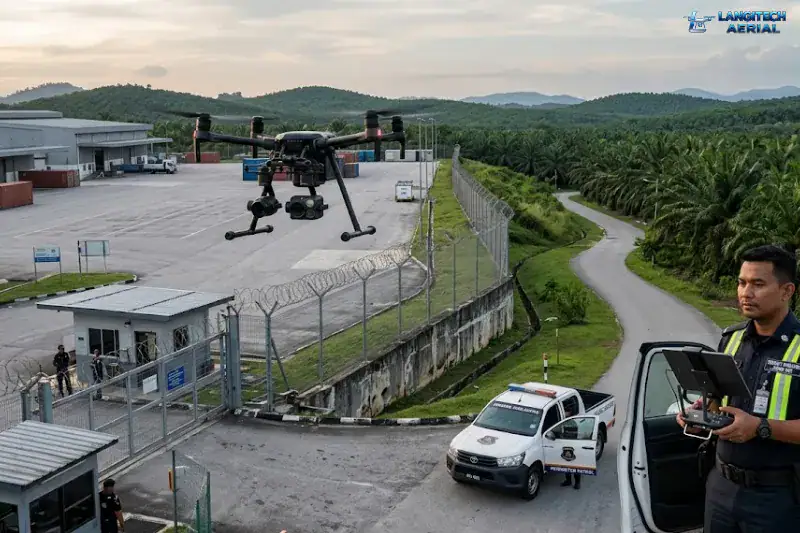
Security is a massive operational challenge for large landholders. Currently, drone security surveillance Malaysia services are rapidly transforming how companies protect their valuable assets. For example, massive estate managers use them to stop illegal timber theft, while industrial sites use them to supplement exhausted ground patrols.
To be clear, this is not about public spying. Instead, this is a legitimate, highly effective tool for asset owners protecting their private property. This guide explains exactly where aerial security adds genuine value and how to navigate the strict legal framework.
Where Drone Security Surveillance Malaysia Actually Works
1. Plantation Estate Boundary Monitoring
Encroachment is a persistent, expensive problem. Specifically, illegal logging, squatting, and agricultural boundary violations plague Sabah, Sarawak, and Peninsular Malaysia. Unfortunately, deploying human teams to patrol thousands of hectares on foot is practically impossible.
Therefore, regular drone patrols offer the perfect solution. They easily monitor massive boundaries and High Conservation Value (HCV) areas. Consequently, they catch encroachment activities early and produce georeferenced photographic evidence for the authorities. Furthermore, this creates a documented audit trail proving that estate management actively secures its land.
2. Industrial Facility Perimeter Security
Massive refineries, ports, logistics hubs, and power plants face unique physical threats. Conventional CCTV cameras possess blind spots, and human guards cannot be everywhere at once.
Aerial patrols effortlessly cover the entire perimeter. They provide a rapid visual response to triggered alarms and survey areas that are completely inaccessible to ground teams. Furthermore, autonomous “drone-in-a-box” systems are currently entering the Malaysian market. These incredible systems automatically launch, patrol, and recharge without any human intervention.
3. Construction Site Security
Construction theft is incredibly expensive. Thieves constantly steal copper cables, steel reinforcements, and heavy equipment overnight. However, periodic aerial patrols during weekends and evenings provide a massive visual deterrent. Ultimately, this dynamic aerial coverage is practically impossible to replicate with standard physical security guards.
The Legal Framework: What CAAM Actually Allows
You cannot simply launch a drone and start filming. First, all commercial flights legally require an Authorisation to Fly (ATF) permit from CAAM, piloted by an RCoC-B certified operator. Additionally, you must never fly over neighboring private properties without explicit permission.
Furthermore, you must respect the [Personal Data Protection Act 2010 (PDPA)]. If your cameras systematically capture identifiable faces, the law applies. Fortunately, monitoring empty industrial perimeters or deep jungle boundaries rarely triggers PDPA issues. Finally, nighttime thermal surveillance requires specific airspace clearances, so you must plan your nocturnal patrols carefully.
Practical Tips for Effective Aerial Security
If you want to implement this technology, follow these strict operational rules:
- Target the High-Risk Hours: Dawn and dusk patrols deter criminals much better than random midday flights.
- Log the GPS Data: Always store your footage with exact timestamps and GPS coordinates. Otherwise, the police cannot use it as legal evidence.
- Integrate, Do Not Replace: Drones complement your existing CCTV and human guards; they do not replace them entirely.
- Train Your Ground Team: The drone only detects the threat. Your human security team must know exactly how to intercept the intruders safely.
Need Help Planning a Compliant Drone Project in Malaysia?
Speak with our team about commercial drone operations, compliance requirements, and the right aerial solution for your project.