
Agriculture Spraying
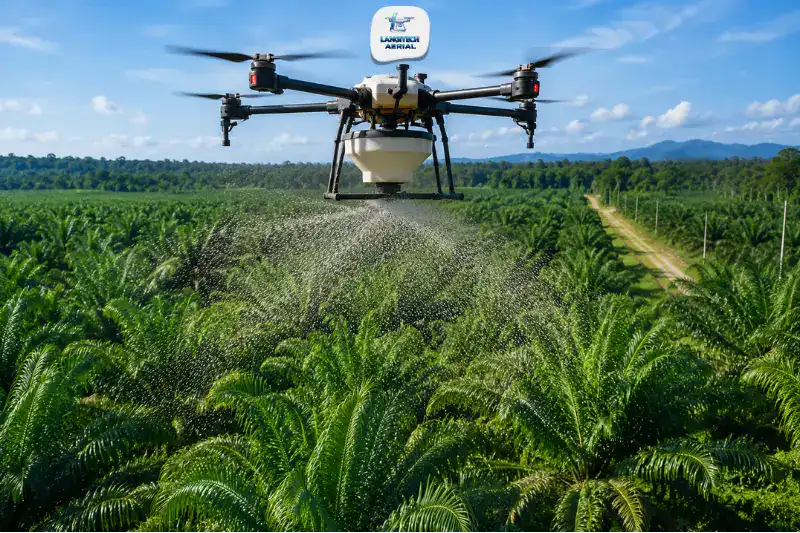
Drone spreading is a distinct service from drone spraying. However, most Malaysian plantation managers do not yet know the difference, or that both are available. Drone spraying delivers liquids through nozzle systems, covering pesticides, herbicides, and liquid foliar fertilisers. Drone spreading delivers granular solids through a centrifugal spreader attachment. That includes compound NPK, muriate of potash (MOP), urea, Christmas Island Rock Phosphate (CIRP), and other dry inputs. Most Malaysian oil palm and paddy fertiliser inputs are granular rather than liquid. So drone spreading opens a mechanisation pathway that drone spraying cannot reach. This guide covers how it works, which products are compatible, how it compares to manual and ground spreading, and what CAAM compliance your provider must hold.
Key Takeaways
- Drone spreading uses a centrifugal spreader attachment rather than spray nozzles. It broadcasts granular fertiliser across plantation blocks from the air.
- Most Malaysian oil palm fertiliser programmes use granular compound NPK, MOP, CIRP, and urea. So drone spreading is a direct mechanisation tool for the bulk of estate fertiliser input.
- Drone spreading covers 3 to 12 hectares per day. By contrast, manual broadcast spreading covers 0.5 to 1 hectare per person per day, and drone distribution is more consistent in spread width and rate.
- Commercial operations need the same CAAM agricultural compliance as spraying: RCoC-B plus Module 2 (AGR), UAWC, and an Agricultural ATF.
Drone Spreading vs Drone Spraying: The Essential Distinction
This distinction matters because many plantation managers assume all drone agriculture involves liquid spraying. Drone spreading is a separate technology. It uses different hardware for a different purpose.
Drone Spraying
Drone spraying uses liquid storage tanks and nozzle systems. It delivers liquid chemicals in fine droplet form to the crop canopy or soil surface. The payload is liquid, the mechanism is pressurised nozzles, and the product must be water-soluble or emulsifiable.
Drone Spreading
Drone spreading uses a hopper and a centrifugal spreader disc. This is the same mechanism as a ground-mounted broadcast spreader, mounted beneath the drone instead. The payload is dry granules, the mechanism is centrifugal force, and the product must be a free-flowing granular solid of suitable particle size.
The practical implication is significant. Your pesticide and herbicide inputs are liquid, so drone spraying handles those. Your granular NPK, MOP, urea, and CIRP inputs are solid, so drone spreading handles those. Both services exist. Therefore a full precision agriculture programme for your estate may well involve both.
How Drone Spreading Works
The Centrifugal Spreader System
A drone spreading setup typically uses a heavy-payload agricultural drone, such as the DJI Agras T40, T50, T60, or a comparable platform. It is fitted with a granule spreading attachment in place of the standard liquid spray system.
The attachment has two parts. First, a hopper of roughly 20 to 50 kg capacity holds the granular fertiliser. Second, one or two centrifugal discs spin beneath it. As the drone flies, granules feed from the hopper onto the discs by gravity. The discs then accelerate the granules and throw them outward in a wide arc. This creates a spread width of 4 to 8 metres either side of the flight path, depending on disc speed, granule size, and altitude.
Then the drone flies pre-programmed parallel passes at consistent altitude and speed. Each pass overlaps the previous one slightly, which keeps distribution uniform across the treatment area.
Coverage Rate and Payload Capacity
Coverage depends on hopper capacity, the application rate per hectare, and flight speed.
DJI Agras T40 with spreading kit (20 kg hopper): At a typical 400 kg/ha rate for NPK compound, the T40 covers about 0.05 ha per hopper load. So field-scale work needs frequent refills, at roughly 2 to 3 minutes per load. In practice, T40 spreading covers 3 to 6 ha per day including refill time.
Heavy-payload spreading drones (50 kg hopper): Larger platforms carry 50 kg hoppers, covering 0.125 ha per load at 400 kg/ha. With faster refill logistics, these reach 6 to 12 ha per day.
Terra Drone’s Kalimantan and Sumatra programme: This used 50 kg payload drones for granular spreading across 60,000 hectares of regional plantation groups, which confirms commercial viability at that payload capacity.
By contrast, a manual worker broadcast spreading granular fertiliser by hand covers 0.5 to 1 hectare per day in Malaysian oil palm terrain. At that rate, one drone replaces roughly 5 to 10 manual spreaders per day. That is a labour substitution ratio comparable to liquid drone spraying.
Fertiliser Products Compatible with Drone Spreading
Not every granular fertiliser suits drone spreading. The centrifugal mechanism needs products that are:
- Free-flowing granules, not powder, not clumped, and not hygroscopic products that absorb moisture and cake in humid conditions
- Uniform in granule size, typically 1 to 5 mm diameter, for consistent disc performance
- Low in dust content, since excessive dust clogs the mechanism and creates wind-carried losses
Compatible Malaysian Oil Palm Products
The following granular types, common in Malaysian oil palm programmes, are generally compatible.
Granular NPK compound fertilisers: Products such as NPK 12:12:17+2MgO (CIRP base) and NPK 15:15:15 are free-flowing with consistent granule size, so they suit centrifugal spreading.
Muriate of Potash (MOP): Granular KCl is a standard Malaysian oil palm potassium source, and it flows well through spreader systems.
Urea (46% N): Prill urea works when fresh and non-clumped. However, urea absorbs moisture readily, which makes it less reliable than NPK compound in high-humidity conditions. So check for caking before loading the hopper.
Christmas Island Rock Phosphate (CIRP): Granular CIRP is compatible, but it produces more dust than compound fertilisers. Use it with caution on windy days, and confirm your provider’s spreader handles CIRP granule characteristics.
Products Not Suitable
Powder fertilisers, liquid fertilisers, and hygroscopic products that cake in Malaysian humidity are unsuitable. These include powdered dolomite (lime), liquid calcium nitrate, and prills that have already clumped from moisture exposure.
Malaysian Crop Applications
Oil Palm: The Primary Application
MPOB’s fertiliser recommendations for Malaysian oil palm typically specify granular NPK compound applications 2 to 4 times a year. The exact schedule depends on soil type, palm age, and target yield. Total annual input per palm runs from 6 to 10 kg for mature producing palms.
Meanwhile, manual spreading in mature oil palm means workers walking inter-rows with 20 to 25 kg bags, broadcasting by hand around each palm base. It is physically demanding and slow, and it accounts for significant annual labour cost.
Drone spreading replaces that operation. The drone broadcasts granular fertiliser across the block from above, distributing material around each palm within its natural spread width. Placement accuracy is not as precise as manual palm-circle placement. However, coverage uniformity across the block is considerably better, including areas that are hard for workers to reach on slopes or in waterlogged conditions.
Paddy: Rice Fertilisation
Malaysian paddy farming uses granular urea and compound NPK at specific growth stages. The standard protocol runs two or three split applications, from transplanting through to panicle initiation. Manual broadcasting on flooded fields is demanding and exposes workers to risk in wet conditions.
Drone spreading applies granular urea and compound NPK across whole fields quickly. This is especially valuable for the critical top-dressing timing that shapes yield outcome. The drone broadcasts across the flooded surface, where the granules dissolve and incorporate into the floodwater as intended.
Rubber: Replanting Nutrition
Young rubber replants need granular NPK nutrition through the immature phase, in years 1 to 5. Drone spreading delivers compound fertiliser across replanting blocks faster than manual teams. Moreover, the consistent distribution reduces the uneven nutrition that causes stand variability in manually fertilised immature rubber.
Drone Spreading vs Manual vs Ground Spreaders
| Factor | Manual Hand Spreading | Ground Spreader Vehicle | Drone Spreading |
|---|---|---|---|
| Coverage rate | 0.5 to 1 ha/day per person | 5 to 15 ha/day | 3 to 12 ha/day |
| Worker chemical exposure | High, direct skin contact | Low, vehicle cab | None, remote operation |
| Terrain access | Limited on slopes and waterlogged areas | Needs trafficable access roads | Unrestricted |
| Distribution uniformity | Variable, worker-dependent | Good on open terrain | Good, consistent disc speed |
| Application rate control | Manual estimation | Mechanical calibration | Programmed and consistent |
| Waste from runoff | Moderate | Moderate | Lower, even distribution reduces over-application |
CAAM Compliance for Drone Spreading
Drone spreading falls under the same CAAM agricultural framework as liquid spraying:
- RCoC-B plus Module 2 (AGR): the pilot’s agricultural operations endorsement from CAAM
- UAWC: the Unmanned Aerial Work Certificate for the operating company
- Agricultural ATF: submitted to drone.agr@caam.gov.my at least 14 working days before each deployment
Additionally, confirm that the granular product you intend to apply appears on the MPOB or DOA Malaysia approved list for aerial application. The DOA Agricultural Payload list covers both liquid and granular inputs, so check for your specific fertiliser before deployment.
For a full compliance guide, read our drone permit Malaysia requirements guide.
Frequently Asked Questions
What is the difference between drone spreading and drone spraying?
Drone spreading delivers dry granular materials such as compound NPK, MOP, urea, and CIRP through a centrifugal spreader disc. Drone spraying delivers liquids such as pesticides, herbicides, and liquid foliar fertilisers through pressurised nozzles. They are completely different payload systems, serve different agronomic purposes, and apply different products. In fact, most Malaysian oil palm and paddy farms need both: spraying for pest and weed management, spreading for granular fertiliser.
Can all drone spraying providers in Malaysia also do drone spreading?
No. Spreading requires a specific granule spreader attachment that most liquid spraying operators do not carry. The hopper and disc system replaces the tank and nozzle configuration entirely. So before booking, confirm that your provider operates a drone fitted with a granule spreading system. Also confirm they have operational experience with the specific granular product you intend to apply.
What application rate is achievable with drone spreading?
Rates depend on your agronomic recommendation per hectare and the drone’s hopper capacity. For oil palm compound NPK at 300 to 500 kg/ha, a standard programme covers 3 to 12 hectares per day, depending on hopper size and refill logistics. For lower-rate applications, such as micronutrient granules at 50 to 100 kg/ha, coverage increases proportionally.
Does drone spreading replace manual fertiliser application entirely?
For broadcasting across open blocks, including oil palm inter-rows and paddy fields, it is a direct replacement for manual broadcast spreading. However, some Malaysian oil palm programmes specify palm-circle placement, meaning granules placed within a defined radius of the palm base. Drone spreading broadcasts across the full inter-row area instead. So where circle placement is specified under MPOB guidelines, discuss circle versus broadcast outcomes with your agronomist before converting fully.
Conclusion
Drone spreading opens granular fertiliser application, the largest volume input in any oil palm or paddy programme, to the same mechanisation benefits that spraying brought to liquid chemicals. The practical outcomes are faster coverage, less manual labour exposure, consistent distribution across difficult terrain, and better documentation.
For estate managers, the key is to distinguish between the two services. Then confirm that any provider offering “drone agriculture” can genuinely deliver both, with the right equipment for each.
LangiTech Aerial provides CAAM-compliant drone spreading alongside our full spraying programme. This covers granular NPK, MOP, urea, and other compatible inputs for oil palm, paddy, and rubber operations across Peninsula Malaysia.
Contact LangiTech Aerial to discuss your fertiliser spreading requirements and get a programme quote.
For a full guide to our liquid spraying services, read our drone crop spraying Malaysia guide and our drone fertiliser Malaysia guide.
Need Help Planning a Compliant Drone Project in Malaysia?
Speak with our team about commercial drone operations, compliance requirements, and the right aerial solution for your project.