
Agriculture Spraying
[INSERT HERO IMAGE HERE — ganoderma-drone-treatment-malaysia-bsr-detection.jpg]
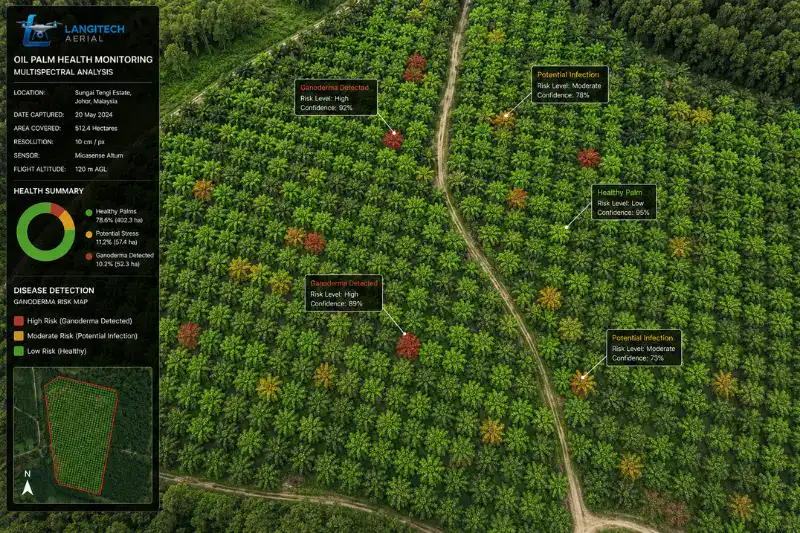
Ganoderma drone treatment in Malaysia combines two capabilities that traditional plantation management can’t deliver together: early aerial detection of Basal Stem Rot (BSR) infection, and targeted treatment of infected zones. Together, they address the single most destructive disease facing Malaysian oil palm today. Ganoderma boninense BSR could infect over 860,000 hectares of Malaysian oil palm by 2040 and already causes 26% to 46% FFB yield reduction in confirmed infected blocks. By the time visible symptoms appear at ground level, the palm typically already carries 50% internal infection. Drone-based detection and treatment changes this equation by identifying stress signatures weeks before ground scouts can, and enabling targeted biological agent delivery to early-stage infection zones. This guide explains how it works.
Key takeaways
- Ganoderma drone treatment in Malaysia uses multispectral imaging to detect BSR-related canopy stress up to 7 to 14 days before visible symptoms appear at ground level.
- Drone aerial application delivers biological control agents, including Trichoderma-based products and biofungicides, to the crown and root zone of at-risk or early-infected palms far faster than ground crews can manage.
- The most effective approach combines survey (detect), mapping (locate), treatment (apply), and monitoring (confirm response) in a structured IDM cycle.
- The most severely Ganoderma-affected regions in Malaysia are Perak, Johor, and Sabah. Estates in these areas get the highest return on investment from drone detection programmes.
Why Ganoderma is Malaysia’s most urgent oil palm problem
Ganoderma boninense, the white rot fungus that causes Basal Stem Rot in oil palm, is the most economically damaging disease in Malaysia’s most important commodity crop. The Malaysian Palm Oil Board (MPOB) has developed 51 technologies across biology, early detection, control, and management of Ganoderma, which gives you a sense of how seriously the industry treats this pathogen.
The scale of the problem is significant. More than 60 million mature oil palms could be infected in Malaysia, and Ganoderma boninense infection could decimate 860,610 hectares of oil palm plantations by 2040. In terms of yield, BSR causes a 26% to 46% reduction in fresh fruit bunch output at 31% to 67% disease incidence. The most severely affected regions are Perak, Johor, and Sabah.
The core challenge is that Ganoderma is hard to detect early. A palm typically reaches 50% internal infection before the fungus becomes detectable through visible signs. By that stage, significant yield damage has already occurred. So early intervention requires detection methods that go well beyond what ground scouting can practically deliver across large blocks.
That’s precisely where drone-based Ganoderma management changes the equation.
How drones detect Ganoderma before visible symptoms appear
Multispectral stress signatures
Drone multispectral imaging identifies Ganoderma-related stress through canopy reflectance anomalies, before the symptoms become visible to ground observers or even to standard aerial photography.
As root and bole tissue decays, an infected palm starts restricting water and nutrient transport to the aerial parts of the plant. This physiological stress shows up as reduced chlorophyll content and changed near-infrared reflectance in the crown, which drone sensors detect via NDVI and NDRE indices. The earliest signs include chlorosis and necrosis of fronds, with young leaves failing to open. Multispectral sensors pick up the pre-symptomatic chlorophyll reduction before any of those visual signs become visible from the ground.
Research into drone-based disease detection in oil palm confirms that multispectral UAV imaging successfully identifies physiological stress in mature palms, including anomalously low canopy vigour in BSR-affected zones, before external fruiting bodies appear on the stem base.
Detection advantage: 7 to 14 days earlier than ground scouting
Multispectral drone surveys identify Ganoderma-related canopy stress 7 to 14 days before it becomes visible to ground scouts walking the plantation. That window allows earlier treatment intervention, which is especially important for biological control agents. Since these agents need more time to establish than chemical fungicides, early application makes a meaningful difference to their effectiveness.
For large blocks in Perak, Johor, or Sabah with known Ganoderma history, quarterly multispectral surveys enable continuous monitoring of disease incidence and spread across the block.
For a detailed guide to multispectral survey capabilities, read our multispectral mapping Malaysia guide.
How drones treat Ganoderma-infected and at-risk palms
Biological control agent application by drone
The primary treatment application in Ganoderma drone treatment Malaysia involves delivering biological control agents to the canopy and root zone of confirmed or suspected infected palms. The most widely MPOB-endorsed biological agents for BSR management include Trichoderma-based biofungicides, antagonistic fungi that colonise the root zone and inhibit Ganoderma spread through competitive exclusion and mycoparasitism.
Drone application delivers these agents in liquid formulation to the palm crown, where the material deposits into the leaf axils and runs down to the root zone, following the same pathway water travels naturally during rainfall. For young palm blocks (immature phase, 1 to 5 years) where Ganoderma risk is highest at replanting, drone application covers the entire block in a fraction of the time that ground crews need.
In addition, drone application reduces worker chemical exposure during biological agent deployment. That’s a relevant consideration given that Trichoderma-based products, while biologically safe, require high-volume application over extended periods in active infection management programmes.
Chemical fungicide application: targeted delivery
For estates that use chemical fungicide treatments as part of their Ganoderma management programme, drone spraying delivers systemic fungicide to the crown and upper root zone of identified infected palms. Critically, this is a targeted approach: it applies chemical only to palms that the preceding multispectral survey flagged, rather than blanket application across the entire block.
Targeted application reduces total chemical volume per block, lowers soil chemical load, and supports MSPO and RSPO responsible agrochemical management documentation requirements.
The Ganoderma drone treatment management cycle
The most effective Ganoderma drone treatment programme follows a structured four-phase cycle aligned with MPOB’s Integrated Disease Management (IDM) framework.
Phase 1: baseline multispectral survey
A pre-season multispectral drone survey of the target blocks generates NDVI and NDRE maps that identify anomalous low-vigour zones. The programme categorises these zones by severity, confirmed symptomatic, suspected early-stage, and healthy, creating the treatment prioritisation map for the programme.
Phase 2: ground verification of flagged palms
Ground inspection teams then visit palms that the multispectral survey flagged as anomalous. They confirm BSR infection (or identify an alternative cause of low vigour), stage disease severity, and validate the aerial detection. This ground verification step protects against misidentification and ensures treatment resources target genuinely infected palms.
Phase 3: targeted drone treatment application
Next, the treatment drone applies biological control agent or fungicide to verified infected palms and their immediate neighbours, the buffer zone where root contact spread is most likely. At-risk palms in the surrounding zone also receive preventive Trichoderma application to inhibit spread.
Phase 4: post-treatment monitoring survey
Finally, a follow-up multispectral survey 30 to 60 days after treatment confirms whether canopy vigour in treated palms is stabilising or declining. Improving NDRE values indicate Trichoderma establishment and halted disease progression. Continued decline in flagged palms may indicate more advanced infection that requires surgical intervention.
This survey-detect-treat-monitor cycle runs quarterly for active Ganoderma blocks and bi-annually for lower-risk blocks.
The financial case for Ganoderma drone treatment
The financial justification for drone-based Ganoderma management is straightforward on estates with confirmed BSR incidence.
A 3.71% BSR incidence survey across Malaysia identified 59,148 hectares of total impacted area, with Perak, Johor, and Sabah most severely affected. At a 30% average FFB yield reduction per infected palm (a conservative estimate within MPOB’s published 26% to 46% range), an estate with 5% BSR incidence across 1,000 hectares loses roughly 1.5% of total FFB production. At RM800 per tonne FFB and typical yields of 18 to 22 tonnes per hectare, that translates to significant annual revenue loss per affected block.
By comparison, a quarterly Ganoderma drone treatment programme combining two multispectral surveys and two targeted treatment applications per year typically costs RM8,000 to RM25,000 per year for a 100 to 500 hectare block, depending on area and treatment volume. On blocks with confirmed incidence, early intervention consistently outperforms a reactive approach on financial terms.
CAAM compliance for Ganoderma drone treatment in Malaysia
All components of a Ganoderma drone treatment programme require CAAM compliance, and the requirements differ between survey and spray operations.
Multispectral survey flights require a CAAM ATF and a JUPEM APK permit, since they involve aerial data capture.
Biological agent spray applications require a CAAM ATF under the Agricultural category (submitted to drone.agr@caam.gov.my), a pilot with RCoC-B plus Module 2 (AGR), and a company UAWC.
In addition, the biological or chemical agents you apply must appear on the DOA Malaysia Agricultural Payload list for aerial drone application. Verify Trichoderma-based biofungicide formulations against the current approved list before deployment. For a full compliance guide, read our CAAM drone regulations Malaysia guide.
FAQ
Can a drone detect Ganoderma BSR before it’s visible at ground level?
Yes. Multispectral drone surveys detect the canopy stress signatures associated with Ganoderma infection 7 to 14 days before ground scouts can observe visual symptoms. The drone identifies anomalous NDVI and NDRE values in the palm crown that indicate physiological stress from reduced water and nutrient transport, a consequence of root and bole tissue decay caused by Ganoderma infection. Ground verification then confirms the cause of the detected stress.
What is the most effective Ganoderma treatment programme using drones?
The most effective approach combines quarterly multispectral detection surveys, ground verification of flagged palms, targeted biological control agent application (Trichoderma-based biofungicide) to infected and buffer zone palms, and post-treatment monitoring surveys. This integrated approach aligns with MPOB’s IDM framework and detects infection earlier, targets treatment more precisely, and tracks response more systematically than ground-based programmes alone.
Which regions in Malaysia have the worst Ganoderma BSR problem?
The most severely affected regions are Perak, Johor, and Sabah, where BSR incidence is highest and economic losses are most concentrated. Estates in these regions, particularly those in their second or third replanting cycle where soil inoculum levels are highest, have the strongest case for implementing drone-based detection and treatment programmes.
How much does a Ganoderma drone treatment programme cost in Malaysia?
A combined quarterly survey and targeted treatment programme for a 100 to 500 hectare block typically costs RM8,000 to RM25,000 per year, depending on block area, treatment volume, and number of survey flights. Compare that against the FFB yield loss from unmanaged BSR progression. On blocks with confirmed incidence above 3%, drone-assisted IDM programmes typically demonstrate a positive financial return within one to two seasons.
Conclusion
Ganoderma drone treatment in Malaysia addresses the most destructive disease in Malaysian oil palm through earlier detection, faster targeted treatment, and systematic monitoring. These are capabilities that ground-based management alone can’t match at plantation scale.
For estates in Perak, Johor, Sabah, and any replanting area with known Ganoderma soil inoculum history, a drone-integrated IDM programme is not experimental technology. It’s a practical, financially justifiable upgrade to existing disease management practices, and one that directly protects FFB yield from a disease that chemical and cultural methods alone have proven insufficient to control.
LangiTech Aerial provides CAAM-compliant Ganoderma drone treatment services in Malaysia, covering multispectral survey, biological agent application, and post-treatment monitoring for oil palm estates across Peninsular Malaysia.
Contact LangiTech Aerial to discuss a Ganoderma management programme for your estate.
For a broader guide to our agriculture drone services, read our drone crop spraying Malaysia guide.
Need Help Planning a Compliant Drone Project in Malaysia?
Speak with our team about commercial drone operations, compliance requirements, and the right aerial solution for your project.