
High-Rise Cleaning
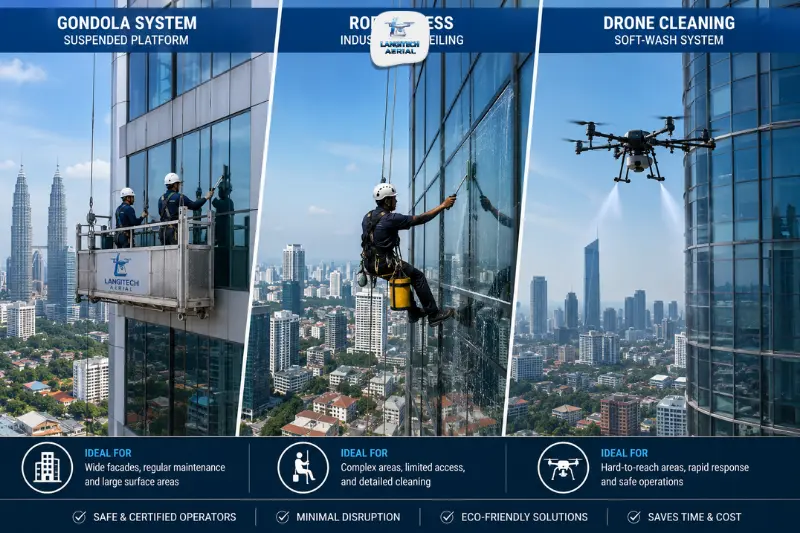
High rise cleaning Malaysia comes down to three methods: gondola systems, rope access abseiling, and drone soft-wash. The one you choose determines your cleaning cost, safety risk profile, tenant disruption level, and compliance overhead. As drone cleaning becomes mainstream alongside the traditional methods that have served the industry for decades, building managers, JMBs, and facilities teams across Malaysia increasingly face this decision. This guide covers how each method works, what each costs in 2026 RM terms, which building types each suits, and when drone cleaning is, and isn’t, the right choice.
Key takeaways
- High rise cleaning Malaysia using drones covers 500 to 800 square metres per hour, far faster than gondola or rope access, at 30% to 50% lower cost on buildings above 20 storeys.
- Gondola systems remain competitive and appropriate on buildings with existing dedicated gondola anchor infrastructure, particularly for complex multi-pass cleaning programmes.
- Rope access is the most flexible method for complex architectural geometry and spot-treatment repairs where crew precision matters more than area coverage speed.
- All three traditional methods carry significant DOSH working-at-height compliance overhead. Drone cleaning eliminates this entirely: no personnel work above 2 metres throughout the operation.
Why high rise cleaning matters in Malaysian buildings
Malaysia’s tropical climate, with its high humidity, intense UV, frequent rainfall, and biological growth, accelerates facade soiling far faster than in temperate climates. Within 6 to 12 months, biological growth establishes itself on glass and cladding surfaces under these conditions. Coastal buildings in Penang, Port Dickson, and Johor Bahru waterfront face additional salt deposition from sea air, while those along KL’s major traffic corridors accumulate carbon particulates from dense urban traffic.
High rise cleaning Malaysia is not optional for building owners and JMBs. Under the Strata Management Act 2013, Joint Management Bodies (JMBs) and Management Corporations (MCs) carry specific maintenance obligations for common property, including building facades. When biological growth is left untreated, it etches into glass coatings and cladding surfaces, causing irreversible degradation that costs far more to repair than regular cleaning costs to prevent.
Method 1: gondola cleaning
How it works
A gondola (BMU, Building Maintenance Unit) is a suspended working platform that travels vertically down the building face from a roof-mounted carriage system. Cleaning crew members ride the gondola and clean the facade manually as it descends, floor by floor.
Gondola systems are either permanently installed on the building, common in purpose-built commercial towers with dedicated BMU infrastructure, or temporarily rigged using a portable suspended platform system anchored at the roofline.
Strengths
- Manual precision. Gondola crew members clean the facade directly, identifying and addressing specific staining, caulk deterioration, and joint condition issues that automated methods may miss.
- Heavy soiling. Manual scrubbing effectively removes heavy biological growth, stubborn deposits, and ingrained contamination that spray-only systems can’t address in one pass.
- Established compliance framework. Gondola operations are well-understood by Malaysian building managers, DOSH inspectors, and insurers, so the compliance pathway is clear.
Limitations
- High cost. Gondola mobilisation, crew, and rigging costs are significant. On a 35-storey tower, a full gondola cleaning programme typically costs RM 35,000 to RM 65,000.
- Setup time. Portable gondola systems require rooftop rigging that takes 1 to 2 days before cleaning can begin, adding to total project time.
- Street-level disruption. Because gondola operations frequently require exclusion zones below the building, they affect pedestrian access, vehicle loading, and building entry points.
- DOSH compliance overhead. Formal working-at-height risk assessment, gondola certification, and competent operator certification are all required under DOSH Malaysia’s Factories and Machinery Act.
Best for
Buildings with permanently installed BMU infrastructure, properties requiring manual scrubbing for heavy soiling or graffiti removal, and programmes where crew access to specific facade details is necessary.
Method 2: rope access cleaning
How it works
Rope access technicians descend from roof anchors using IRATA-certified rope systems, working directly on the building face while suspended. They carry cleaning equipment and clean manually while managing their position through controlled rope descent.
Strengths
- Architectural flexibility. Unlike gondola systems, rope access reaches recessed panels, architectural fins, cantilevered features, curved surfaces, and facades with complex setback geometry.
- No rooftop infrastructure required. Since rope access only needs anchor points at the roofline rather than a dedicated BMU carriage system, it works on buildings without permanent gondola infrastructure.
- Spot treatment precision. For specific facade areas needing targeted cleaning, sealing, or repair, rope access puts the crew exactly where they need to be.
- Lower mobilisation cost vs gondola. Rope access equipment is portable and faster to set up than permanent gondola rigging.
Limitations
- Coverage speed. Rope access technicians cover less area per day than gondola or drone methods, typically 200 to 400 square metres per technician per day.
- DOSH compliance. IRATA certification for operators, formal working-at-height risk assessment, and rescue plan documentation are all required under DOSH Malaysia guidelines.
- Weather sensitivity. Wind above 8 to 10 metres per second stops rope access operations, which is more restrictive than drone systems in Malaysian conditions.
- Insurance overhead. Personal accident and public liability insurance for rope access operations carries higher premiums than comparable drone cleaning operations.
Best for
Buildings with complex architectural geometry, spot treatment of specific facade areas, facade sealing and repair alongside cleaning, and situations where gondola infrastructure is unavailable.
Method 3: drone soft-wash cleaning
How it works
A drone fitted with a water delivery system applies cleaning solution to the building facade from the air, typically at 3 to 8 metres standoff distance. The soft-wash system uses low-pressure delivery with deionised or reverse osmosis water and appropriate cleaning solution, maintaining consistent coverage across the facade without the high pressure that damages coatings and sealants.
Strengths
- Speed. Drone soft-wash covers 500 to 800 square metres per hour, far faster than gondola or rope access for large glass and curtain wall facades.
- No personnel at height. Because the drone operator works from ground level throughout, there are no DOSH working-at-height obligations, no gondola certifications, and no rope access qualifications needed.
- Lower cost at scale. On buildings above 20 storeys, drone cleaning typically costs 30% to 50% less than equivalent gondola programmes. See our drone cleaning cost Malaysia guide for detailed RM figures.
- Minimal disruption. With no street-level exclusion zones, rooftop rigging, or building entry restrictions, operations proceed while the building remains fully occupied.
- CAAM compliant. LangiTech Aerial manages ATF permit applications as part of every deployment.
Limitations
- Not suitable for heavy soiling. Soft-wash delivery can’t replace manual scrubbing for heavy biological crusts, graffiti, or deeply ingrained industrial contamination. Heavily soiled facades may need a preparatory manual clean before drone soft-wash maintenance programmes become effective.
- Not appropriate for low-rise buildings. Below 8 to 10 storeys, the economics don’t favour drone cleaning over traditional methods, since the CAAM permit overhead and equipment setup costs make gondola or rope access more cost-effective.
- Surface compatibility. While soft-wash works well for glass, curtain wall, ACP (aluminium composite panels), and standard painted concrete, porous stone, speciality coatings, and heritage materials need surface-specific assessment before drone cleaning.
Best for
High-rise curtain wall towers above 10 storeys, regular maintenance cleaning programmes, solar panel arrays, large industrial rooftops, and occupied commercial buildings where tenant disruption must be minimised.
High rise cleaning Malaysia: method comparison
| Factor | Gondola | Rope access | Drone soft-wash |
|---|---|---|---|
| Coverage rate | 300–500 m²/day | 200–400 m²/day | 500–800 m²/hour |
| Personnel at height | Yes | Yes | No |
| DOSH compliance | Full regime | Full regime | Not applicable |
| Complex geometry access | Moderate | Excellent | Good |
| Heavy soiling removal | Excellent | Excellent | Limited |
| Facade disruption | High | Moderate | Minimal |
| Cost: 35-storey tower | RM 35,000–65,000 | RM 28,000–55,000 | RM 15,000–32,000 |
| Setup time | 2–3 days | 1 day | 2–4 hours |
| Insurance overhead | High | High | Standard |
| Street disruption | Significant | Moderate | None |
| CAAM ATF required | No | No | Yes |
Choosing the right high rise cleaning Malaysia method
Drone soft-wash when:
- The building is 10 storeys or above with a glass curtain wall or ACP facade
- Maintenance cleaning (not heavy soiling removal) is the objective
- Tenant disruption must be minimised
- A regular annual or bi-annual programme is planned
- Cost efficiency at scale is the primary driver
Gondola when:
- Existing BMU infrastructure is already installed on the building
- Heavy soiling, graffiti, or biological crust requires manual scrubbing
- Facade details need crew access for caulk or sealant inspection alongside cleaning
- The building sits in a restricted airspace zone where drone ATF is complex
Rope access when:
- Complex architectural geometry, fins, recesses, cantilevers, prevents gondola and drone access to specific areas
- Spot cleaning or targeted facade repairs sit alongside the cleaning scope
- No gondola infrastructure exists and the facade geometry is complex
- The programme requires both cleaning and technical facade inspection in one mobilisation
Combine methods when:
The most effective high rise cleaning Malaysia programme often mixes methods. Drone soft-wash handles the main glass curtain wall area, fast and cost-effective at scale, while rope access covers complex architectural detail areas, decorative elements, and caulk inspection that drone systems can’t reach with the same precision.
DOSH compliance for high rise cleaning Malaysia
Traditional high rise cleaning Malaysia methods, gondola and rope access, trigger full working-at-height compliance obligations under DOSH Malaysia’s Factories and Machinery Act and Occupational Safety and Health Act 1994:
- Formal working-at-height risk assessment
- BOSIET or working-at-height competency certification for operators
- Gondola/rope access equipment certification and inspection
- Rescue plan documentation
- Site safety supervision
Drone soft-wash removes the working-at-height classification entirely, since all personnel stay at ground level. As a result, the entire DOSH compliance overhead for the cleaning operation disappears, replaced by CAAM ATF permit management, which LangiTech handles as part of every deployment.
Frequently asked questions
Is drone cleaning available for all buildings in Malaysia?
Drone cleaning suits most commercial and residential high-rise buildings in Malaysia above 10 storeys with glass curtain wall, ACP, or standard cladding facades. However, buildings in restricted airspace zones near KLCC, Subang Airport, or Putrajaya need extra CAAM/authority coordination that extends the permit lead time. Always confirm airspace feasibility early in the planning process.
How often should high-rise buildings be cleaned in Malaysia?
In Malaysia’s tropical climate, most commercial towers benefit from bi-annual cleaning, once every 6 months. Coastal buildings in Penang, Port Dickson, and Johor Bahru waterfront benefit from quarterly cleaning due to salt deposition. Those along high-traffic KL corridors accumulate carbon particulates faster and may also need quarterly programmes. For solar panel arrays, bi-annual cleaning is the minimum for maintaining generation performance.
Can gondola and drone cleaning be combined on the same building?
Yes, and in practice this is often the most practical approach. Drone soft-wash covers the main curtain wall efficiently, while rope access or gondola handles complex architectural features, recessed panels, and any heavy soiling areas that drone soft-wash can’t fully address. If your building has both large curtain wall areas and complex architectural details, discuss a combined method programme with your provider.
Conclusion
High rise cleaning Malaysia in 2026 is no longer a choice between gondola and rope access alone. Drone soft-wash has established itself as the most cost-effective and operationally straightforward method for large curtain wall and glass facade maintenance on buildings above 10 storeys, delivering faster coverage, lower cost, and zero working-at-height risk.
That said, the right choice still depends on your building’s height, facade type, soiling level, airspace location, and whether heavy soiling removal or regular maintenance is the primary objective. For most Malaysian commercial towers above 15 storeys on a regular cleaning programme, however, drone soft-wash delivers the best combination of speed, cost, and safety outcome.
LangiTech Aerial provides CAAM-compliant drone high rise cleaning Malaysia services across Peninsula Malaysia, for commercial towers, hotel facades, residential condominiums, and industrial facilities.
Contact LangiTech Aerial for a site assessment and cleaning programme quote.
For detailed pricing, read our drone cleaning cost Malaysia guide. For window-specific cleaning, read our drone window cleaning Malaysia guide.
Need Help Planning a Compliant Drone Project in Malaysia?
Speak with our team about commercial drone operations, compliance requirements, and the right aerial solution for your project.