
Agriculture Spraying
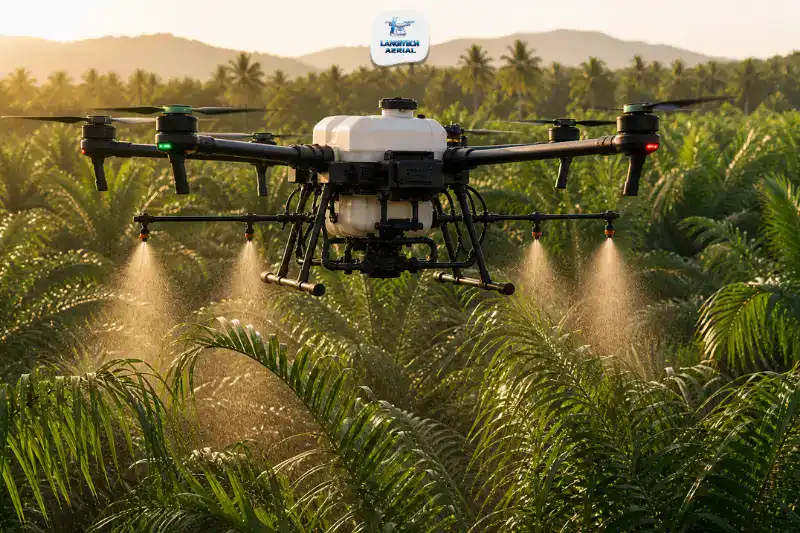
Oil palm drone spraying has become the most practical method for managing pests, weeds, and nutrient deficiencies across Malaysian estates. Research from the Malaysian Palm Oil Board (MPOB) confirms what estate managers across Perak, Johor, and Selangor have observed firsthand — aerial spraying delivers faster response times, higher efficacy rates, and significantly lower worker exposure than conventional trunk injection or manual methods. This guide covers how it works, when to use it, what the data shows, and what to look for in a compliant provider.
Key Takeaways
- Oil palm drone spraying is 40 times faster than traditional manual sprayers and reduces water usage by up to 90% per hectare
- MPOB research confirms 96% larval reduction in bagworm infestations within 28 days of the first drone spray session
- All commercial operations require CAAM RCoC-B certification and a UAWC — not just a standard flight permit
- Drone spraying integrates with multispectral mapping for zone-based precision application, reducing chemical usage by 30% to 40%
Why Oil Palm Estates in Malaysia Are Switching to Drone Spraying [MUST HAVE]
The Labour and Scale Problem
Malaysia manages over 5.67 million hectares of oil palm — the world’s second-largest producing nation. The scale of this industry creates a structural challenge. The manual labour required to spray, fertilise, and manage pests across these estates far exceeds the available workforce.
Manual spraying teams carry backpack pressure sprayers and work tree by tree under direct pesticide exposure. Recruitment and retention of these workers has become increasingly difficult. Furthermore, reliance on foreign labour introduces cost and operational uncertainty. Oil palm drone spraying addresses this directly — one drone operator manages a system that covers the work of 40 manual sprayers at comparable cost.
The Consistency Problem
Manual spraying on oil palm estates is inherently variable. Application rates differ between workers and between sessions. Consequently, some blocks receive adequate treatment while others — particularly on slopes or areas difficult to reach on foot — receive insufficient coverage or none at all.
Aerial spraying, by contrast, follows a pre-programmed flight path with fixed flow rates and spray height. As a result, every palm in the treated block receives the same chemical dosage — regardless of terrain variation or operator fatigue.
What Oil Palm Drone Spraying Is Used For [MUST HAVE]
Bagworm Control — The Most Critical Application
Bagworm (Metisa plana, Pteroma pendula, Mahasena corbetti) is the most economically damaging pest in Malaysian oil palm. Outbreaks are recurring — particularly in Perak and Johor. Unmanaged infestations reduce yields by up to 43% over two subsequent years.
Oil palm drone spraying is now the preferred response method for large-scale outbreaks. It replaces the slower and more hazardous trunk injection (TCI) approach. According to MPOB research, aerial spraying of Bacillus thuringiensis (Bt) bioinsecticide achieved a 96% reduction in Metisa plana larval population within 28 days of the first application.
A separate FGV study in 2022 covered a combined outbreak area of over 1,272 hectares. Drones applying flubendiamide at 36 litres per hectare brought live bagworm counts to zero within 30 days after treatment. Notably, this approach is 40 times faster than conventional trunk injection — a critical advantage when timing directly determines yield outcome.
Herbicide Application
Weed competition is a significant yield loss factor on Malaysian oil palm estates. Weeds compete directly with palms for soil nutrients and moisture. Traditional herbicide application by ground crew is time-consuming and creates chemical exposure risk for workers.
Oil palm drone spraying for herbicide uses weed pressure mapping to identify high-density zones. The drone then delivers targeted treatment to those zones only. In practice, this reduces herbicide usage compared to blanket ground spraying and protects surrounding drainage channels.
Foliar Fertiliser Application
Liquid foliar fertilisers deliver micronutrients directly to palm fronds during key growth phases. Ground-based foliar application on mature oil palm is physically demanding — palms reach 10 to 15 metres at maturity, making canopy coverage difficult without aerial delivery.
Drone application delivers foliar nutrients uniformly at the correct spray height and droplet size. This is particularly valuable on estates running MPOB-aligned precision nutrition programmes. Specifically, it supports blocks identified as deficient through leaf sampling or multispectral analysis.
Rhinoceros Beetle and Secondary Pest Management
Beyond bagworm, this service supports control of rhinoceros beetle (Oryctes rhinoceros), nettle caterpillar, and other secondary pests. Furthermore, early-stage Ganoderma basal stem rot management programmes increasingly integrate aerial chemical delivery as part of treatment protocols on affected blocks.
The ETL Framework: When to Trigger Oil Palm Drone Spraying [DIFFERENTIATOR]
One of the most important — and least discussed — concepts in oil palm pest management is the Economic Threshold Level (ETL). The ETL, as defined by MPOB, is the pest population level at which intervention becomes economically justified.
Intervening at or just below ETL — before the infestation peaks — consistently produces better outcomes than reactive treatment after a major outbreak has developed. Moreover, early intervention reduces the total chemical volume required across the season.
Oil palm drone spraying is particularly suited to ETL-triggered response because of its speed. A large-scale outbreak covering hundreds of hectares can be treated within days. By contrast, mobilising a manual trunk injection programme for the same area takes weeks. Therefore, pairing regular scouting data with a drone spraying provider that can mobilise quickly is the operationally optimal strategy for most Malaysian estates.
Precision Approach: Mapping Combined with Targeted Spraying [DIFFERENTIATOR]
The most advanced programmes combine two drone services — multispectral aerial mapping and precision targeted spraying — into a single integrated workflow.
First, a multispectral drone survey produces NDVI and SAVI crop health index maps across the estate. Zones with anomalous readings are flagged as potential pest hotspots, nutrient deficiency areas, or disease-affected blocks.
Then, the estate manager and agronomist review the maps and define treatment zones. Rather than spraying the entire estate, only the flagged zones receive treatment.
Finally, the spraying drone executes targeted treatment on those zones only. Parameters are set specifically for each zone’s crop condition and treatment requirement.
This precision approach reduces total chemical usage by 30% to 40% compared to blanket estate-wide spraying. Additionally, it produces a documented, spatially referenced record of where, when, and at what dosage treatment was delivered — directly supporting MSPO and RSPO audit requirements.
For a broader overview of drone mapping for plantation applications, read our smart farming Malaysia drone guide.
IPM Integration: Where Drone Application Fits [DIFFERENTIATOR]
Oil palm drone spraying is not a replacement for Integrated Pest Management (IPM). It is, however, the most effective tool for the aerial application component of an IPM programme.
A well-structured IPM framework for bagworm management on a Malaysian estate typically includes these components:
- Biological controls: Planting beneficial plants such as Turnera subulata to support natural enemy populations that prey on bagworm larvae
- Monitoring and scouting: Regular frond census to track larval populations relative to ETL
- Targeted aerial treatment: Drone spraying with Bt-based bioinsecticides when ETL is reached
- Post-treatment monitoring: Follow-up frond census at 28 and 60 days after spraying to confirm efficacy
MPOB data from long-term IPM study plots demonstrates that bagworm populations can be maintained below ETL for more than three years after a well-executed aerial spraying programme. In other words, oil palm drone spraying within an IPM framework is a sustainable long-term investment — not simply a reactive response tool.
CAAM Compliance for Oil Palm Drone Spraying [DIFFERENTIATOR]
Commercial oil palm drone spraying in Malaysia requires regulatory compliance that goes beyond a standard flight permit. Many estate managers engage operators without checking these requirements. Consequently, the result can range from invalid insurance coverage to regulatory penalties.
RCoC-B Pilot Certification: Every commercial drone operator must hold the Remote Pilot Certificate of Competency — Basic (RCoC-B) from CAAM. This is the minimum requirement for any commercial drone flight in Malaysia.
UAWC — Unmanned Aerial Work Certificate: For commercial aerial work operations — including oil palm drone spraying — the operator must additionally hold the UAWC from CAAM. This covers the specific operational, safety, and competency standards for aerial application work. A provider holding only an RCoC-B is not fully compliant for commercial spraying.
Authorisation to Fly (ATF): Every individual deployment requires a site-specific ATF from CAAM. Your provider should apply for this as part of their service and provide a copy before operations begin.
Always ask your provider to confirm all three credentials before signing a contract. For a complete guide to drone regulations, read our CAAM drone regulations Malaysia guide.
Oil Palm Drone Spraying vs Trunk Injection [ADVANTAGE]
Trunk Chemical Injection (TCI) was the standard bagworm control method on Malaysian oil palm estates for decades. However, oil palm drone spraying has largely replaced it for large-scale outbreak response.
| Factor | Trunk Injection (TCI) | Oil Palm Drone Spraying |
|---|---|---|
| Speed | 1–2 ha per team per day | 15–40 ha per drone per day |
| Worker exposure | High — direct chemical contact | Minimal — operator at safe distance |
| Efficacy on outbreak | Slow systemic uptake | Rapid foliar knockdown |
| Coverage uniformity | Variable by worker | Uniform — programmed parameters |
| Documentation | Manual records | Digital flight log and coverage map |
| MSPO/RSPO audit trail | Limited | Full digital record per session |
For estates managing outbreak areas above 50 hectares, aerial spraying consistently outperforms TCI on speed and uniformity. TCI retains a role for localised treatments and preventive systemic applications on individual trees. However, for area-wide outbreak response, drone-based aerial application is the operationally superior choice.
What a Post-Spray Report Should Include [DIFFERENTIATOR]
After every professional session, your provider should deliver a post-spray report. This forms part of your agrochemical management documentation for MSPO and RSPO certification audits.
A complete oil palm drone spraying report must include:
- GPS-tagged flight logs with timestamps and coverage map of treated areas
- Chemical volume applied per hectare and total across the treated block
- Droplet size and spray rate settings used during the operation
- Drone equipment details — model, registration number, nozzle type
- Operator certification details — RCoC-B and UAWC certificate numbers
- Pre-spray and post-spray photography of the treatment area
- Recommended follow-up action — next scouting date or repeat spray timing
If your provider cannot produce a report matching this standard, their documentation will not support MSPO or RSPO compliance requirements. Therefore, always request a sample report before committing to a contract.
Frequently Asked Questions
How effective is drone spraying for bagworm control in Malaysian oil palm?
According to published MPOB research, Bt-based bioinsecticide applied by drone achieved 96% larval reduction in Metisa plana within 28 days of the first spray. A separate 2022 FGV study confirmed zero live bagworm counts at 30 days after treatment with flubendiamide. Furthermore, long-term MPOB IPM data shows populations can be maintained below ETL for more than three years after a well-executed aerial spraying programme.
How many hectares can a drone spray per day on an oil palm estate?
A heavy-payload drone — such as the DJI Agras T50 with a 40-litre tank — covers approximately 15 to 40 hectares per day on oil palm. This depends on terrain, chemical application rate, and block layout. By contrast, trunk injection covers only 1 to 2 hectares per team per day — making drone-based aerial spraying up to 40 times faster for outbreak response.
What certifications must an oil palm drone spraying operator hold in Malaysia?
Your provider’s operators must hold three credentials. First, the RCoC-B pilot certification from CAAM. Second, the UAWC (Unmanned Aerial Work Certificate) for aerial work operations. Third, a site-specific Authorisation to Fly (ATF) for each deployment. Always request documentation for all three before operations begin.
Can this service replace trunk injection entirely for bagworm management?
For large-scale outbreak response covering 50 or more hectares, oil palm drone spraying is operationally superior to TCI in speed, coverage, and documentation. However, TCI retains value for localised treatments and individual tree management. In practice, most well-managed estates use both tools within an IPM framework — aerial spraying for area-wide response, TCI for targeted follow-up.
Does oil palm drone spraying data support MSPO certification?
Yes. Every professional session produces GPS-tagged flight logs, coverage maps, chemical application records, and operator certification details. This digital audit trail directly supports the agrochemical management documentation requirements of both MSPO and RSPO certification frameworks.
Conclusion
Oil palm drone spraying is no longer experimental on Malaysian estates. MPOB research confirms its efficacy. Operational data from large-scale deployments across Perak, Johor, and Selangor demonstrates its speed advantage. Furthermore, its integration with multispectral mapping and IPM frameworks makes it a precision management tool — not just a faster way to spray.
The key, therefore, is choosing a provider who holds full CAAM compliance — RCoC-B plus UAWC — delivers complete post-spray documentation, and has experience on oil palm terrain across Malaysian estates.
LangiTech Aerial provides CAAM-compliant oil palm drone spraying services across Peninsula Malaysia, covering bagworm control, herbicide, foliar fertiliser, and integrated pest management programmes.
Contact LangiTech Aerial to discuss your estate’s requirements and get a spraying quote.
For a broader guide to drone crop spraying across all Malaysian crops, read our drone crop spraying Malaysia guide.
Need Help Planning a Compliant Drone Project in Malaysia?
Speak with our team about commercial drone operations, compliance requirements, and the right aerial solution for your project.