
High-Rise Cleaning
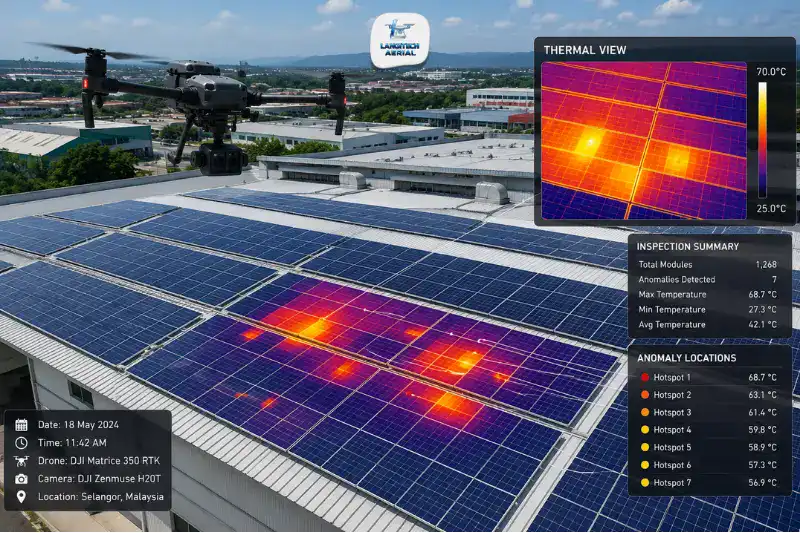
Thermal drone inspection detects the solar panel faults that visual checks and SCADA monitoring miss. That includes hotspots, string failures, bypass diode faults, and cell delamination. Better still, it scans an entire rooftop or ground-mount array in hours rather than days. Malaysia’s solar sector has grown fast through SEDA’s Net Energy Metering (NEM) programme and the Large Scale Solar (LSS) tenders. As a result, thousands of systems now sit across commercial buildings, industrial rooftops, and ground-mount farms, and all of them need periodic inspection. So this guide covers how drone thermal inspection works, which faults it detects, how Malaysian conditions affect quality, and what a professional report should deliver.
Key Takeaways
- Drone inspection uses a radiometric thermal camera to detect temperature anomalies across panel surfaces. In turn, it identifies hotspots, string outages, PID, and bypass diode failures that SCADA cannot pinpoint at panel level.
- The correct condition in Malaysia needs at least 600 W/m² solar irradiance and wind below 5 m/s. Inspections in cloudy weather, or during the northeast monsoon (November to March), produce unreliable thermal data.
- A professional report maps every fault to its GPS-referenced panel location, classifies fault type and severity, and recommends corrective action. In short, it is not just a folder of thermal images.
- Every drone solar inspection needs a CAAM ATF, and the pilot must hold a valid RCoC-B certificate.
Why Solar Panels Fail, and Why SCADA Misses It
Malaysian solar PV installations lose output through degradation and faults that begin at the cell and module level. The problem is one of measurement. String inverters and SCADA systems measure electrical output at the string or inverter level, not at the individual panel. So a single faulty panel in a 20-panel string causes a small drop that SCADA logs as minor underperformance. Meanwhile, that faulty panel may be generating heat, degrading further, and damaging adjacent cells.
Furthermore, hardware underperformance across the global solar industry grew 214% between 2019 and 2024. This cost an estimated USD 10 billion in lost generation. The systematic cause is too little inspection at the module level. After all, manual on-foot inspection of large arrays runs at 25 hours per MW. So it is far too slow and expensive to run often enough to catch faults early.
Drone thermal inspection solves this. A drone with a radiometric thermal camera covers 50 to 100 MW per day at 95% to 99% fault detection accuracy. As a result, it identifies panel-level temperature anomalies that correlate directly with electrical faults.
How Drone Thermal Inspection Works
The Physics of Thermal Fault Detection
Every photovoltaic panel converts sunlight into electricity and heat. A healthy panel spreads that heat evenly across the cell surface. However, a faulty cell converts less sunlight to electricity and more to heat, whether it is damaged, shaded, or electrically compromised. So its raised temperature relative to healthy cells becomes the thermal signature that drone inspection detects.
A radiometric thermal camera records absolute temperature values for every pixel. This sets it apart from a basic thermal imager. During the flight, it captures the precise temperature of every point on every panel. Then processing software analyses the data to find temperature anomalies above defined thresholds.
Flight Conditions for Malaysian Inspection
Malaysia’s tropical climate creates specific conditions that affect thermal quality.
Minimum irradiance: Thermal fault signatures only appear when panels generate current under load. This needs at least 600 W/m² of solar irradiance. Malaysian skies meet that reliably between roughly 9am and 3pm in the dry season. However, cloud cover during the northeast monsoon (November to March) often prevents it.
Wind speed: Wind above roughly 5 m/s cools panel surfaces through convective heat loss. As a result, it compresses the temperature gap between faulty and healthy cells and makes anomalies harder to detect. Malaysian coastal and elevated sites are especially prone to morning wind.
Time of day: The optimal window in Malaysia is usually 10am to 2pm. During that window, irradiance is high, the sun angle loads panels consistently, and wind speeds tend to be lower than early morning or late afternoon.
Ambient temperature: Malaysia’s high ambient temperatures, from 28°C to 36°C, mean panels run hot even when healthy. So delta-T, the difference between a faulty and a healthy cell, is a more reliable indicator than absolute temperature here. Therefore, a properly calibrated report presents delta-T values, not just raw temperatures.
Fault Types Detected by Drone Inspection
Hotspots and Cell Damage
Hotspots are the most common thermal anomaly in Malaysian arrays. They appear as localised high-temperature zones, typically 5°C to 30°C above the surrounding healthy cells. Common causes include:
- Cracked or broken cells from impact, transport damage, or thermal cycling stress
- Cell mismatch within a module, where one cell underperforms and the rest force current through it as a resistive load
- Shadowing from structures, trees, or debris that makes one cell operate as a reverse-biased load
Hotspots accelerate panel degradation. Left undetected, a single hotspot can spread to adjacent cells over 12 to 24 months. Eventually, that causes module failure.
String Outages and Open Circuits
A string outage shows all panels in a series string at uniformly low or zero temperature relative to adjacent strings. This indicates an open circuit. Causes include blown string fuses, failed MC4 connectors, failed bypass diodes that break the string, or a disconnected combiner box terminal.
String outages often appear in SCADA data as zero-output strings. However, finding which connector or component failed needs thermal imaging to trace the temperature profile along the string.
PID: Potential-Induced Degradation
PID appears as elevated temperature across a large diagonal or triangular part of a panel. Alternatively, it shows as consistent warming across all panels in a string. It signals voltage-leakage degradation driven by high system voltages relative to frame grounding. This is especially relevant in Malaysian systems using higher-voltage string configurations.
PID is a cumulative mechanism. So early detection lets operators adjust system voltage or install PID recovery devices before major power loss.
Bypass Diode Failures
Each panel contains bypass diodes that protect cells from reverse-bias damage during partial shading. A failed diode, whether open or short circuit, creates a distinctive thermal pattern. For example, a shorted diode shows as a cool stripe across the affected cell group. By contrast, an open diode shows as a hotspot in the cells the diode was meant to protect.
These failures are common in Malaysian installations exposed to sustained high operating temperatures. In short, that follows from Malaysia’s consistently high ambient conditions and the elevated panel temperatures they cause.
Delamination and Moisture Ingress
Delamination is where the encapsulant layer between the cells and the front glass or rear backsheet separates. As a result, it creates irregular hotspot patterns or “snail trail” thermal signatures. Moisture ingress after seal failure around panel edges creates variable anomalies that worsen after rainfall. Both are more common in older Malaysian installations exposed to extended UV and humidity cycling.
What a Professional Report Delivers
A professional thermal report goes well beyond a folder of images. It should include:
- Georeferenced fault map: Each fault pinned to its exact GPS location on an orthomosaic of the array, so crews can find the specific panel without searching.
- Fault classification: Each anomaly classified by type (hotspot, string outage, PID, bypass diode) and severity (minor, moderate, critical) using IEC 62446-3 delta-T thresholds.
- Corrective action: A specific recommended action per fault, such as clean, monitor, replace module, or inspect wiring, prioritised by estimated generation impact.
- Thermal and RGB image pairs: Both a thermal and a standard RGB image of each fault. The thermal image identifies the anomaly, while the RGB image shows the physical context.
- Condition documentation: Recorded irradiance, wind speed, ambient temperature, and time of each pass, confirming that conditions met the 600 W/m² minimum.
A report with only thermal images, and no classification, GPS mapping, or condition data, does not give O&M teams actionable instructions.
When and How Often to Inspect
Post-installation acceptance: After a new NEM or LSS installation, a thermal inspection before handover confirms that all panels produce correctly. It also confirms that no installation defects exist, such as mismatched cells, damaged panels, or loose connections.
Annual O&M inspection: Most O&M contracts under SEDA’s NEM and LSS frameworks specify an annual performance inspection. So a dry-season inspection, typically March to October in Peninsula Malaysia, provides the panel-level fault data those reports require.
Post-severe weather: After typhoon-grade winds, hail, or flooding, a post-event inspection documents storm damage for insurance claims. In turn, it prioritises emergency repair work.
Pre-sale or pre-refinancing: For solar assets being sold, refinanced, or transferred under NEM panel-swapping arrangements, an independent report gives buyers and lenders an objective condition assessment.
CAAM Compliance for Drone Solar Inspection
Every drone solar inspection needs the following approvals.
CAAM ATF: First, you need an Authorisation to Fly from CAAM, applied for at least 14 working days before each inspection. Rooftop inspections in urban areas may need extra airspace clearances, such as near airports, sensitive zones, or controlled airspace.
RCoC-B pilot certification: All commercial drone operations need an RCoC-B certified pilot. Thermal inspection with a calibrated radiometric payload does not need a separate thermal certification under Malaysian CAAM rules. However, the report analyst should still hold appropriate thermal analysis competency.
For a full compliance guide, read our drone permit Malaysia requirements guide.
Frequently Asked Questions
How is drone solar panel inspection different from solar panel drone cleaning?
Drone cleaning removes soiling, such as dust, bird droppings, and biological growth, from panel surfaces using a soft-wash water system. Thermal inspection instead uses a radiometric thermal camera to detect electrical and structural faults inside the panel, including hotspots, cell damage, bypass diode failures, and delamination. So the two services address different problems and use entirely different payloads. In fact, many Malaysian O&M programmes schedule both. They run annual thermal inspection to find faults and bi-annual cleaning to maintain output.
What irradiance is needed for reliable solar inspection in Malaysia?
At least 600 W/m² of solar irradiance is required for thermally detectable fault signatures. Below that level, panels generate too little current to produce detectable temperature differentials between faulty and healthy cells. In Malaysia, this condition is reliably met between 9am and 3pm during dry-season months. However, the northeast monsoon (November to March) often brings overcast skies that prevent inspection-quality irradiance in east coast states. Therefore, schedule inspections in the March to October window for the most reliable results.
What is the IEC 62446-3 standard, and does it apply to Malaysian inspections?
IEC 62446-3 is the international standard for photovoltaic system inspection using thermography. It defines minimum irradiance conditions, delta-T classification thresholds for fault severity, and reporting requirements. Malaysian NEM and LSS O&M contracts increasingly reference it as the quality standard for thermal reports. So confirm that your provider’s report format and operating conditions comply with IEC 62446-3 before you commission the inspection.
Conclusion
Thermal drone inspection gives O&M managers, building owners, and solar investors the panel-level fault visibility that SCADA cannot provide. Hotspots, string outages, bypass diode failures, and PID degradation are all detectable from the air. Moreover, each one is pinpointed to a GPS-referenced panel location and classified by severity in a report that drives maintenance action.
In Malaysian conditions, quality comes down to two things. First, timing: dry season, at least 600 W/m² irradiance, and wind below 5 m/s. Second, a report format that goes beyond thermal images to deliver classified, georeferenced, actionable fault data.
LangiTech Aerial provides CAAM-compliant drone solar panel inspection services for rooftop commercial arrays, industrial installations, and ground-mount systems across Peninsula Malaysia.
Contact LangiTech Aerial to talk through your solar array inspection and get a quote.
For solar panel cleaning services, read our solar panel drone cleaning Malaysia guide.
Need Help Planning a Compliant Drone Project in Malaysia?
Speak with our team about commercial drone operations, compliance requirements, and the right aerial solution for your project.