
High-Rise Cleaning
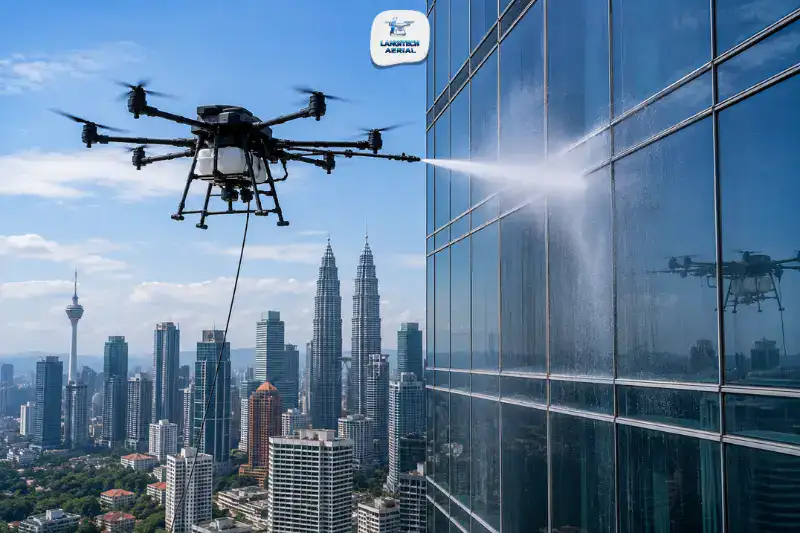
Drone window cleaning Malaysia gives building managers, JMBs, and facilities teams a way to maintain high-rise glass facades without gondolas, scaffolding, or rope access workers suspended at height. As Malaysia’s urban skyline grows — from KLCC and the KL Golden Triangle to Penang’s Georgetown waterfront and JB’s Iskandar high-rises — the maintenance challenge of glass curtain walls and tower facades grows with it. This guide covers how drone window cleaning works in Malaysia, which building types it suits, what it costs, and what CAAM compliance your provider must hold.
Key Takeaways
- Drone window cleaning Malaysia removes the need for gondola systems, suspended platforms, or rope access for routine glass facade maintenance
- The soft-wash delivery system uses low-pressure application combined with deionised or reverse osmosis water — preventing streaks and protecting coated glass surfaces
- All commercial drone window cleaning operations in Malaysia require a CAAM ATF; operations near KL city buildings require additional airspace coordination
- Drone window cleaning typically costs 30% to 50% less than gondola cleaning on buildings above 20 storeys
What Is Drone Window Cleaning Malaysia?
Drone window cleaning Malaysia uses unmanned aerial vehicles fitted with a low-pressure soft-wash delivery system to clean glass windows, curtain walls, and glazed facades on high-rise buildings — from the ground, without any personnel working at height.
The drone carries an onboard solution tank or connects to a ground-based pump via a lightweight hose for continuous coverage of large facades. It flies a systematic pattern at a precise standoff distance from the glass surface. LiDAR or ultrasonic sensors maintain this consistent distance throughout the operation. This ensures the cleaning solution applies uniformly across the entire facade — regardless of building setbacks, cantilevered balconies, or architectural recesses.
The result is a thorough, streak-free clean delivered faster and more safely than any traditional access method. Furthermore, the drone operator manages the entire operation from ground level throughout.
Why Malaysian High-Rise Buildings Need Regular Window Cleaning
Malaysia’s Climate Accelerates Soiling
Malaysia’s tropical climate — high humidity, frequent rainfall, and intense UV exposure — accelerates the accumulation of biological growth, dust, vehicle exhaust particulates, and atmospheric pollutants on glass facades. Coastal buildings in Penang and Port Dickson face additional salt deposition from sea air. Buildings along major KL roads — KLCC, Jalan Bukit Bintang, Jalan Sultan Ismail — accumulate carbon particulates from dense traffic.
Without regular cleaning, biological growth establishes on glass surfaces within 6 to 12 months. Left untreated, this growth etches into glass coatings and permanently degrades the facade’s appearance. Therefore, regular drone window cleaning Malaysia programmes protect both the building’s visual presentation and its long-term glass asset value.
Strata Management Act 2013 Obligations
For residential and mixed-use towers managed under the Strata Management Act 2013, Joint Management Bodies (JMBs) and Management Corporations (MCs) carry specific obligations for common property maintenance — including building facades.
Drone window cleaning Malaysia provides JMBs and MCs with a practical, cost-effective way to fulfil these maintenance obligations without the safety risk, insurance overhead, and operational disruption of gondola or rope access programmes. Furthermore, each drone cleaning session generates a documented completion report — supporting the maintenance records that strata management audits require.
DOSH Working-at-Height Risk Elimination
Under the Occupational Safety and Health Act 1994 and DOSH Malaysia guidelines, any work conducted above 2 metres requires formal risk assessment, fall protection equipment, and a competent supervisor. Gondola maintenance and rope access programmes on high-rise buildings carry substantial DOSH compliance overhead.
Drone window cleaning Malaysia eliminates the working-at-height classification entirely for the cleaning operation. The drone operator works from ground level. Consequently, the entire DOSH compliance burden associated with suspended access disappears.
How Drone Window Cleaning Malaysia Works
Step 1 — Site Survey and Flight Planning
Before any deployment, the LangiTech team conducts a building site survey to assess the facade geometry, glazing type, soiling level, and any airspace constraints. The survey informs the flight path design, cleaning solution selection, and pump pressure settings for the specific building.
For tall buildings in dense urban areas — particularly within KL’s city centre — the team identifies nearby airspace boundaries, building setbacks, and any obstacles that affect the drone’s approach path. This site survey forms the basis of the CAAM ATF application that follows.
Step 2 — CAAM ATF Application
All commercial drone window cleaning Malaysia operations require an Authorisation to Fly (ATF) from CAAM. The application covers the building location, flight dates, and operational parameters. LangiTech applies for the ATF as part of every deployment — at least 14 working days before the scheduled cleaning date.
For buildings in proximity to airports or in controlled airspace — including many buildings in the Bayan Lepas area of Penang and along the KLIA corridor — additional Air Traffic Control coordination is required. Always confirm your provider handles this.
Step 3 — Water Treatment and Solution Preparation
Before the drone deploys, the team prepares the cleaning solution using deionised or reverse osmosis (RO) purified water. This step is critical for streak-free results on glass.
Tap water in Malaysia contains dissolved minerals — calcium, magnesium, and silica — that leave white spotting residue as water evaporates from glass surfaces. Deionised water removes these minerals entirely. As a result, the cleaned glass dries without spotting or streaking — even in Malaysia’s humid conditions where evaporation is slow. This is the same technology professional car detailers use for streak-free rinses on painted surfaces.
Step 4 — Systematic Cleaning Operation
The drone executes a pre-programmed cleaning path, working systematically across the building facade in vertical or horizontal swaths. LiDAR or ultrasonic proximity sensors maintain a consistent standoff distance from the glass — typically 30 to 80 centimetres — throughout the operation.
The soft-wash system delivers the cleaning solution at low pressure. This is different from pressure washing — soft-wash preserves glass coatings, sealants, and gaskets that high-pressure application would damage. Meanwhile, the drone’s downward and lateral airflow assists in agitating the cleaning solution across the glass surface for improved coverage.
Step 5 — Quality Review and Completion Report
After the cleaning operation, the operator conducts a visual quality review using the drone’s camera system. Any areas requiring additional attention receive a second pass. LangiTech then delivers a completion report confirming the cleaned area, solution used, and flight documentation — supporting your building’s maintenance records.
Which Building Types Suit Drone Window Cleaning Malaysia
Glass Curtain Wall High-Rises
Curtain wall buildings — where the entire exterior skin consists of floor-to-ceiling glass panels in aluminium frames — represent the primary application for drone window cleaning Malaysia. These buildings are common across KL’s Golden Triangle, Putrajaya’s government precinct, and Penang’s commercial centre.
Curtain wall cleaning by gondola requires a dedicated anchor system on the rooftop, trained gondola operators, and significant time per floor. Drone cleaning covers the same area systematically and without rooftop access requirements. Consequently, drone window cleaning on curtain wall buildings typically completes 3 to 4 times faster than an equivalent gondola programme.
Structural Glazing Facades
Structurally glazed facades use silicone bonding rather than metal frames to hold glass panels. The structural silicone gaskets require gentle cleaning to prevent degradation. Drone soft-wash is compatible with structural glazing — the low-pressure delivery protects the silicone bonds that conventional pressure washing can compromise.
Mixed-Use Tower Podiums
Lower podium floors of mixed-use towers — retail, F&B, and commercial levels — typically feature complex architectural glazing with canopies, recesses, and decorative glass elements. These areas are often difficult for gondola systems to access cleanly. Drone window cleaning Malaysia navigates these complex geometries precisely, accessing recessed panels and cantilevered features that conventional methods cannot reach.
Residential Condominium Towers
High-rise residential condominiums managed by JMBs under the Strata Management Act represent a major and growing market for drone window cleaning Malaysia. The combination of strata maintenance obligations, resident-facing aesthetics requirements, and the operational sensitivity of working around occupied residential units makes drone cleaning an attractive alternative to intrusive gondola programmes.
Drone Window Cleaning Malaysia vs Gondola Cleaning
| Factor | Gondola Cleaning | Drone Window Cleaning Malaysia |
|---|---|---|
| Personnel at height | Yes — gondola operators | No — all ground-based |
| Setup time | Hours (rigging, anchor checks) | 30–60 minutes (equipment setup) |
| Speed on 40-storey tower | 3–5 days | 1–2 days |
| DOSH compliance overhead | Full regime required | Not applicable |
| Access to complex geometry | Limited on recesses, cantilevers | Unrestricted navigation |
| Water usage | High | Low — deionised soft-wash |
| Facade disruption | Significant — gondola visible | Minimal — drone works externally |
| Cost for 40-storey curtain wall | RM 25,000 – RM 60,000 | RM 12,000 – RM 30,000 |
The cost comparison is compelling for buildings above 20 storeys. On a 40-storey curtain wall tower, drone window cleaning Malaysia typically costs 30% to 50% less than a full gondola cleaning programme. Furthermore, the time saving reduces disruption to tenants and building operations.
CAAM Compliance for Drone Window Cleaning Malaysia
Commercial drone window cleaning Malaysia operations require a valid CAAM ATF. LangiTech Aerial manages this application as part of every deployment. Key compliance considerations for window cleaning operations include:
Urban airspace: Buildings in KL’s city centre sit in complex urban airspace. Operations must comply with CAAM’s separation requirements from other buildings, utility lines, and public areas. The ATF application covers these parameters specifically.
RCoC-B pilot certification: All LangiTech pilots hold the CAAM Remote Pilot Certificate of Competency — Basic (RCoC-B). This is mandatory for all commercial drone operations in Malaysia.
Insurance: Commercial drone window cleaning Malaysia operations require valid public liability insurance naming the operator and the building owner. LangiTech carries comprehensive commercial drone insurance on all deployments.
For a full guide to drone permits and compliance, read our CAAM drone regulations Malaysia guide.
Drone Window Cleaning Malaysia Cost Guide
Pricing varies by building height, facade area, glazing type, and access complexity. As a guide for 2026 Malaysian market conditions:
| Building Type | Drone Window Cleaning (est. RM) |
|---|---|
| Low-rise commercial (5–10 floors) | RM 3,000 – RM 7,000 |
| Mid-rise tower (15–25 floors) | RM 7,000 – RM 18,000 |
| High-rise tower (30–50 floors) | RM 15,000 – RM 35,000 |
| Supertall (50+ floors) | Quotation required |
| Curtain wall podium cleaning | RM 2,500 – RM 6,000 |
For a full breakdown of drone cleaning pricing, read our drone cleaning services Malaysia guide.
Frequently Asked Questions
Is drone window cleaning safe for coated or tinted glass?
Yes — drone window cleaning Malaysia uses a soft-wash low-pressure delivery system, not high-pressure water blasting. The cleaning solution and application pressure are compatible with standard glass coatings, low-e coatings, tinted glass, and structural silicone gaskets. LangiTech assesses the glazing type during the pre-deployment site survey and adjusts the cleaning solution and pressure accordingly.
How often should high-rise buildings schedule drone window cleaning in Malaysia?
In Malaysia’s tropical climate, most commercial towers benefit from bi-annual cleaning — once every six months. Buildings in coastal areas (Penang, Port Dickson, Johor Bahru waterfront) or high-traffic urban locations (KLCC corridor, Bukit Bintang) accumulate soiling faster and benefit from quarterly cleaning. JMBs managing residential towers typically schedule annual cleaning as part of the annual maintenance budget.
Can drone window cleaning work on buildings with complex architectural features?
Yes — this is one of drone window cleaning Malaysia’s key advantages over gondola systems. The drone navigates recesses, cantilevers, fins, and angled glass features that gondola systems cannot access cleanly. Complex architectural glazing that has never received proper cleaning with traditional methods is often the most visually impactful application for drone window cleaning.
How long does a drone window cleaning Malaysia project take?
A 30-storey curtain wall tower typically requires 1 to 2 days of drone cleaning operations, depending on facade area and soiling level. Setup, CAAM permit preparation, and water treatment add to the overall project timeline. Contact LangiTech at least 3 to 4 weeks before your required cleaning date to allow for ATF permit processing.
Conclusion
Drone window cleaning Malaysia gives building owners, JMBs, and facilities managers a safer, faster, and more cost-effective way to maintain high-rise glass facades. It eliminates working-at-height risk, removes the gondola compliance overhead, and delivers a streak-free result that deionised soft-wash technology makes possible — even in Malaysia’s humid tropical conditions.
The key is choosing a CAAM-compliant provider with the right drone system for your building’s glazing type, the experience to navigate complex urban airspace, and the documentation process your strata or building maintenance records require.
LangiTech Aerial provides CAAM-compliant drone window cleaning Malaysia services across Peninsula Malaysia — covering curtain wall towers, structural glazing, mixed-use podiums, and residential condominium facades.
Contact LangiTech Aerial for a site assessment and drone window cleaning quote.
Need Help Planning a Compliant Drone Project in Malaysia?
Speak with our team about commercial drone operations, compliance requirements, and the right aerial solution for your project.