
Agriculture Spraying
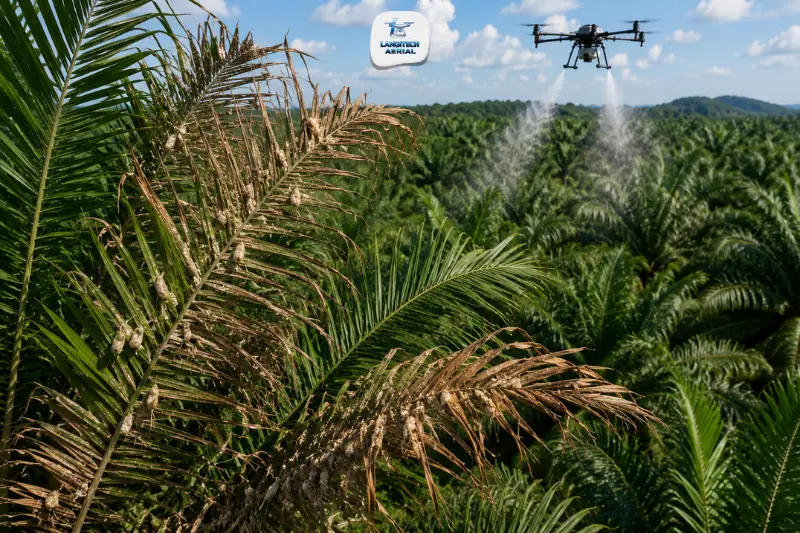
Bagworm drone control Malaysia is now the standard response for large-scale Metisa plana outbreaks in Malaysian oil palm, and the research evidence from MPOB and FGV estate operations confirms why. Drone aerial spraying of Bacillus thuringiensis bioinsecticide achieved 96% larval reduction within 28 days in published MPOB research. In 2022, FGV’s Besout estate operations covered 1,272 hectares of combined outbreak area, and drone-applied flubendiamide reduced live bagworm counts to zero within 30 days, completing in 5 days what traditional trunk injection would have taken weeks to achieve. This guide covers everything estate managers need to know about using drones for bagworm control: species identification, the Economic Threshold Level, treatment timing, chemical and biological options, and how early multispectral detection changes the intervention window.
Key takeaways
- Bagworm drone control Malaysia achieves results 40 times faster than conventional trunk injection. Timing directly determines whether an outbreak can be contained before yield damage compounds.
- Three bagworm species affect Malaysian oil palm: Metisa plana, Pteroma pendula, and Mahasena corbetti. Each has different lifecycle characteristics that affect treatment timing.
- The Economic Threshold Level (ETL) for bagworm in Malaysian oil palm is 5 to 8 larvae per frond. Treatment above this threshold is economically justified. Below it, monitor and reassess.
- All commercial bagworm drone control Malaysia operations require CAAM RCoC-B + Module 2 (AGR), UAWC, and an Agricultural ATF before deployment.
Why bagworm is Malaysia’s most economically damaging oil palm pest
Bagworm, primarily Metisa plana Walker and Pteroma pendula Joannis (Lepidoptera: Psychidae), and to a lesser extent Mahasena corbetti, is the single most economically damaging pest in Malaysian oil palm. Outbreaks recur particularly in Perak and Johor, where populations can defoliate entire blocks rapidly under suitable outbreak conditions.
The financial stakes are high. Serious bagworm infestations reduce oil palm FFB yields by up to 43% over two subsequent years, because defoliation at one point in the cycle affects not only the immediately harvested bunches but also the bunch initiation of the following season. An estate manager who delays bagworm drone control Malaysia treatment by two to three weeks during an active outbreak risks yield damage that the current or following crop year can’t recover from.
A well-executed drone aerial spraying programme started at or slightly above the ETL, on the other hand, can suppress bagworm populations below the economic threshold for three or more years, according to MPOB’s long-term Integrated Pest Management (IPM) data.
Bagworm species in Malaysia: identification and lifecycle
Metisa plana Walker
The most common and economically damaging bagworm species in Malaysian oil palm, M. plana larvae construct narrow, elongated silk cases, typically 15 to 25 mm in length, that hang from palm fronds by a silken thread. Feeding occurs at night, with larvae retreating into their cases during daylight.
The M. plana lifecycle spans approximately 3 to 4 months from egg hatch to adult emergence. Population build-up is exponential: a low initial population can reach outbreak density within a single generation under favourable conditions. Because of this rapid growth, early detection and fast response are the two critical success factors in bagworm drone control Malaysia.
Pteroma pendula Joannis
P. pendula cases are rounder and more compact than M. plana. This species tends to infest older palms more severely and is common in Johor plantation areas. Its lifecycle is broadly similar to M. plana, though response to aerial spraying may differ slightly by species. Confirm effective products against current MPOB recommendations.
Mahasena corbetti
Less common than Metisa and Pteroma but present in some Malaysian plantation areas, M. corbetti produces larger cases and tends to cause scattered individual palm defoliation rather than the concentrated block-scale outbreaks typical of M. plana and P. pendula.
The Economic Threshold Level (ETL) for bagworm drone control Malaysia
The ETL is the pest population level at which intervention becomes economically justified: where the cost of treatment is exceeded by the yield loss that would result from not treating. For Malaysian oil palm bagworm management:
ETL for mature oil palm. 5 to 8 larvae per frond (LPF), depending on palm age, current FFB price, and treatment cost. At current FFB prices above RM 700 per tonne, the ETL sits at the lower end of this range.
Monitoring protocol. Systematic frond sampling surveys, typically every 2 to 4 weeks during active monitoring periods or monthly during lower-risk periods, count larvae per frond across representative palms in each block.
Action points:
- Below 3 LPF: Continue monitoring, no treatment required
- 3 to 5 LPF: Increase monitoring frequency, prepare treatment logistics
- Above 5 LPF: Initiate bagworm drone control Malaysia treatment immediately
- Above 10 LPF: Emergency response, outbreak is active, immediate intervention essential
When defoliation becomes visible from the block boundary, the population has typically already exceeded 15 to 20 LPF, well above the ETL. By that point, significant yield damage for the current bunch development cycle has already begun.
Treatment options for bagworm drone control Malaysia
Biological control: Bacillus thuringiensis (Bt)
Bt-based bioinsecticides are the MPOB-preferred treatment for bagworm control in Malaysian oil palm, specifically Btk (Bacillus thuringiensis kurstaki), which targets Lepidoptera larvae. Published MPOB research confirms that Bt aerial spraying achieves 96% larval reduction in M. plana within 28 days of the first spray.
Bt is the preferred option when:
- The outbreak sits at early-to-moderate population density (above ETL, not yet at severe defoliation)
- MSPO or RSPO certification compliance requires biological pesticide preference documentation
- The estate sits near watercourses or sensitive environmental areas where chemical pesticide runoff risk must be minimised
Drone application. Bt products disperse in water and deliver well through drone spray systems at standard agricultural application rates. Canopy penetration from drone delivery is considerably better than trunk injection for reaching the frond surface where larvae feed.
Chemical insecticide: flubendiamide
Flubendiamide (diamide group) is the primary chemical treatment option for severe outbreaks, where population density is high and rapid knockdown is needed before further defoliation compounds yield damage.
The 2022 FGV Besout estate operation confirmed the efficacy of flubendiamide at 36 litres per hectare applied by drone with fan nozzles. At 30 days after treatment, the survey recorded zero live bagworms across the 1,272 hectare combined outbreak area, demonstrating that drone-applied flubendiamide achieves rapid, complete population knockdown at commercial scale.
Flubendiamide is the preferred option when:
- Population density is severe and immediate knockdown is the priority
- The Bt treatment window has passed and the outbreak is advancing
- The estate agronomist determines that rapid knockdown is required to protect bunch development in progress
Resistance management. Rotate flubendiamide with Bt and other insecticide modes of action between outbreak seasons to prevent resistance development in bagworm populations.
Why drone delivery beats trunk injection for bagworm control
Traditional trunk injection (TCI), systemic insecticide delivered by injection directly into the palm trunk, was the standard Malaysian bagworm treatment before aerial spraying became accessible. For all outbreak scenarios, drone bagworm control is now clearly the better choice.
Speed. A drone covers 15 to 40 hectares per day depending on platform and application rate. Trunk injection covers approximately 60 to 100 palms per person per day, requiring days or weeks to treat the same area. In a rapidly escalating outbreak, that speed difference directly determines yield outcome.
Canopy coverage. Drone delivery targets the frond surface where larvae feed. Trunk injection routes systemic insecticide through the palm’s vascular system, which works but reaches larvae more slowly. Drone delivery also achieves upper frond coverage that manual canopy spraying from ground level can’t reach in mature palms.
Safety. Trunk injection sends workers into active outbreak areas, carrying injection equipment through dense, infested fronds with direct contact risk. Drone operators stay at ground level throughout.
Scale. A single drone deployment covering 100 to 500 hectares of outbreak area delivers treatment within a timeline that protects the current season’s yield. To treat the same area by trunk injection, a contractor needs multiple days of manual crew operations.
Early detection: multispectral drone survey for bagworm monitoring
The most cost-effective bagworm management integrates drone multispectral survey into the monitoring programme, not just drone spraying for treatment.
Multispectral surveys detect the canopy stress signature of early-stage bagworm defoliation before visible frond damage appears at the block boundary or ground level. NDVI (Normalised Difference Vegetation Index) and NDRE (Normalised Difference Red Edge) analysis identifies palms with anomalously low canopy vigour, flagging early outbreak centres for targeted ground verification.
Catching an outbreak at 3 to 5 LPF rather than 15 to 20 LPF delivers three clear advantages:
- Lower treatment cost, since less chemical is needed at lower population density
- Faster knockdown, because a smaller initial population responds faster to Bt
- Less yield damage, as intervention happens before bagworms affect bunch development
For a guide to multispectral crop health monitoring, read our multispectral mapping Malaysia guide.
CAAM compliance for bagworm drone control Malaysia
All commercial bagworm drone control Malaysia operations require full CAAM agricultural compliance:
- RCoC-B + Module 2 (AGR) — pilot must hold the agricultural operations endorsement from CAAM
- UAWC — the operating company must hold an Unmanned Aerial Work Certificate from CAAM
- ATF (Agricultural) — submitted to drone.agr@caam.gov.my at least 14 working days before deployment
Before deployment, confirm that the treatment product appears on the DOA Malaysia Agricultural Payload list for aerial drone application. Check both Bt formulations and flubendiamide products against the current approved list.
For a full compliance guide, read our drone permit Malaysia requirements guide.
Frequently asked questions
How quickly can a bagworm drone treatment be deployed after detection?
With LangiTech Aerial, from initial contact to deployment readiness typically takes 3 to 4 weeks, covering 14 working days for CAAM ATF processing and scheduling logistics. For estates in known high-risk outbreak states (Perak, Johor), pre-emptive ATF applications at the start of peak bagworm season, typically March to June and September to November, cut emergency response time considerably.
How many hectares can a drone treat per day for bagworm control?
A DJI Agras T50 or equivalent heavy-payload drone covers 15 to 40 hectares per day for bagworm treatment, depending on terrain, application rate, and block layout. At 36 L/ha application rate (the FGV Besout programme standard), a T50 with its 40-litre tank covers approximately 1 hectare per tank load. Refill logistics determine daily throughput as much as flight capability does.
When is the right time of year to conduct bagworm monitoring in Malaysia?
Peak bagworm outbreak risk periods correspond broadly to dry spells and periods of rapid population build-up, commonly March to June and September to November. That said, outbreaks can occur year-round in severely affected blocks. Monthly frond sampling throughout the year, with increased frequency during known risk periods, is the monitoring cadence MPOB’s IPM guidelines recommend.
Conclusion
Bagworm drone control Malaysia is the most time-critical agricultural drone application in Malaysian oil palm, because every week of delay in treating an active outbreak adds yield damage that the current or following season can’t recover from.
The evidence is clear. MPOB research and FGV commercial operations both confirm that drone aerial spraying, whether with Bt biological products or flubendiamide, controls M. plana outbreaks at large scale, in short timeframes, and at efficacy levels that trunk injection can’t match on outbreak areas above 50 hectares.
The key is preparation: monitoring regularly against the ETL, having a CAAM-compliant provider lined up before outbreak conditions materialise, and using multispectral drone surveys to detect early-stage population build-up before it reaches outbreak density.
LangiTech Aerial provides CAAM-compliant bagworm drone control Malaysia services for estates across Peninsula Malaysia, covering emergency outbreak response and routine preventive spraying programmes.
Contact LangiTech Aerial to discuss your estate’s bagworm monitoring and treatment requirements.
For a full guide to oil palm drone services, read our oil palm drone spraying Malaysia guide.
Need Help Planning a Compliant Drone Project in Malaysia?
Speak with our team about commercial drone operations, compliance requirements, and the right aerial solution for your project.